Under dicTation.
The true story of the romanza 'A vucchella' by F. P. Tosti
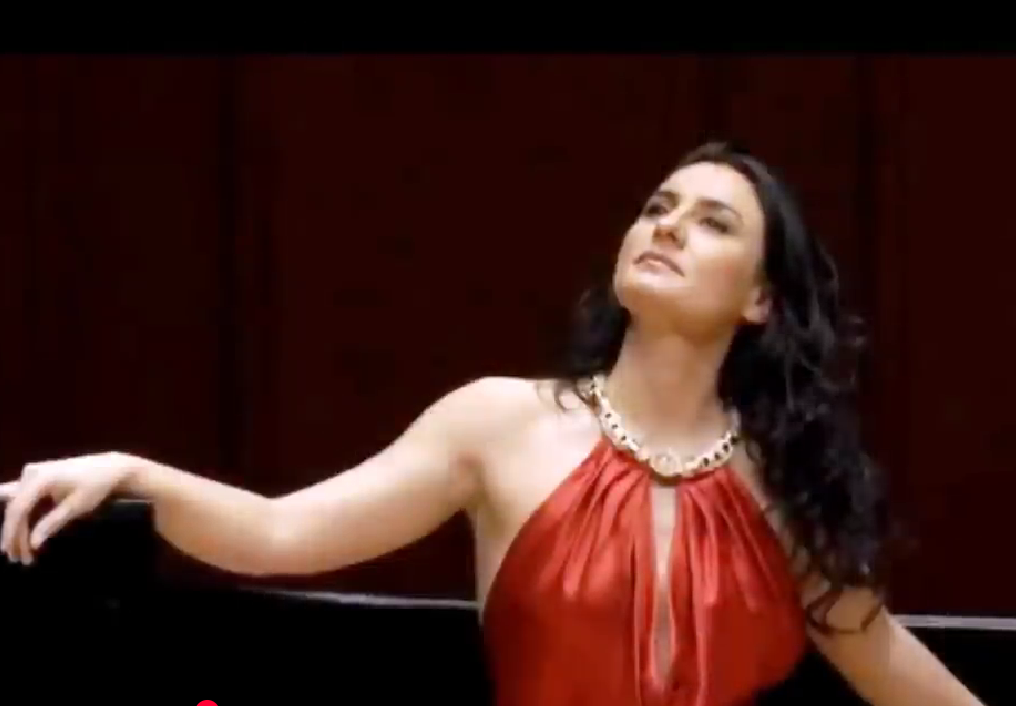
Above: screenshot shared from https://www.youtube.com/watch?v=_9TNWV_fwKk&list=RD_9TNWV_fwKk&start_radio=1
A very pleasant and well-known romance, most often sung by celebrated tenors[1], reached me instead through the beautiful voice and splendid presence of a young soprano whose talent is finally beginning to be acclaimed. It is 'A vucchella’, in the interpretation of Carmela Remigio[2].
The origin of this elegant serenade intrigued me, also because the author does not seem to have made use of it as much as the antagonist who extorted it from him.
In fact, dating back to 1892, there was a challenge that Ferdinando Russo, a journalist for Naples' ‘Il Mattino’, posed to his young Abruzzese colleague Gabriele D'Annunzio, accusing him of not knowing the language of Naples.
We can imagine the fiery Poet vehemently accepting and - from what is still preserved in the archives of the very central and still renowned 'Caffè Gambrinus', in whose salons arguments between literati and the cultured were not infrequent - starting to write on the spot those delightful verses we still enjoy today. However, despite the promise of silence made to D'Annunzio, who feared for his reputation, Russo sold those stanzas about fifteen years later; they were then set to music by the refined composer Francesco Paolo Tosti, he too of Abruzzese origin, and quickly spread to great acclaim.
I thought of Jacques Lacan, the French psychoanalyst[3] who became passionate about Freud - already known in those years well beyond Vienna’s borders - and of that work of the unconscious upon which many contemporaries instead cast envious shadows. Lacan's technique in analytical work remains a 'must' for psychoanalysts until today, and his unprecedented competence was revealed by his Seminar titled 'The Freudian Thing'[4], in which he indicated 'the inaccessible' as the lemma reported by patients in analytical work, around which the very difficulty of a work unfolds.
"Thus, the functions of mastery, ...establish on the foundation of a libidinal alienation the development that follows..." - Lacan says in the text, adding: "The identification of ‘I’ with the Other precipitated in the subject has the effect that this distribution never constitutes a harmony, even a kinetic one, but is instituted on the permanent 'either you or me' of a war in which the existence of one or the other is at stake..."[5]
"However, it is in this register that the systematic analysis of defense is uttered. It is corroborated by the semblances of regression. The object relation provides its appearances, and this forcing has no other way out than one of the three revealed in the current technique. Either the impulsive leap into the real... Or the transient hypomania through ejection of the object itself... Or in that kind of somatization that is hypochondria 'kept to a minimum'..."[6]
Remaining within neurosis, in short, without working about it, the patient is left with no choice but to passively accept that rigid alternation so finely detailed by Lacan.
D'Annunzio, therefore, while rapidly constructing this enchanting song, patiently submitted to the laws of ‘Es’[7], which dictated to him without alternative—as in an "either you or me" war—the words that were to escape Consciousness, bewitched by their evocative sound. A desire—that of turning himself into an object of enjoyable courtship—which the Warrior Poet, reputedly an unstoppable lover as well as a diligent combat pilot[8], would never have revealed except in such an odious condition.
The oneirism, as we know, feeds even art—and not only poetic art—but nothing forces it except one’s ‘desire’.
Marina Bilotta Membretti/ Cernusco sul Naviglio – May 16, 2019.
TutorSalus.net – Freudian journalism
[1] Enrico Caruso, Roberto Murolo, and Luciano Pavarotti are the most well-known, but not the only ones.
[2] Carmela Remigio is an Italian soprano. In 2016, she received the prestigious "Franco Abbiati Prize of Italian Music Critics". "'A vucchella" is part of her album "Arias" (2010).
[3] Jacques Lacan (1901-1981), a psychiatrist and psychoanalyst, founded the Societè Francaise de Psychanalyse in 1953 with Daniel Lagache and, in the same year, began the 'Seminaire' that would give its name to a famous series of publications.
[4] 'The Freudian Thing. Meaning of the Return to Freud in Psychoanalysis' / Amplification of a lecture delivered at the Neuropsychiatric Clinic of Vienna on November 7, 1955. In "Écrits", translation edited by Giacomo B. Contri, Einaudi Publishing 2002 – Vol. I, pp. 391-428.
[5] 'The Freudian Thing' in "Écrits", translation edited by Giacomo B. Contri, Einaudi Publishing, Vol. I p. 420.
[6] 'The Freudian Thing' in "Écrits", translation edited by Giacomo B. Contri, Einaudi Publishing, Vol. I p. 421.
[7] The ‘Es’, which does not coincide with the unconscious, stands in contrast to the Superego: Freud discusses it, for example, in "The ‘I’ and the ‘Es’” (1923), Biblioteca Bollati Boringhieri.
[8] Gabriele D'Annunzio (1863-1938) was an Italian writer, poet, journalist, soldier, and politician who symbolized Decadentism. During World War I, at the age of 52, he obtained permission to participate in naval and aerial actions and subsequently led the occupation of the city of Fiume, which had not been assigned to Italy (1919-1921). Despite being among the first signatories, along with Filippo Tommaso Marinetti, of the 'Manifesto of the Fascist Intellectuals', he never held a membership card for the National Fascist Party.