A better world.
“What is the right way to land on a better world ?”[1]
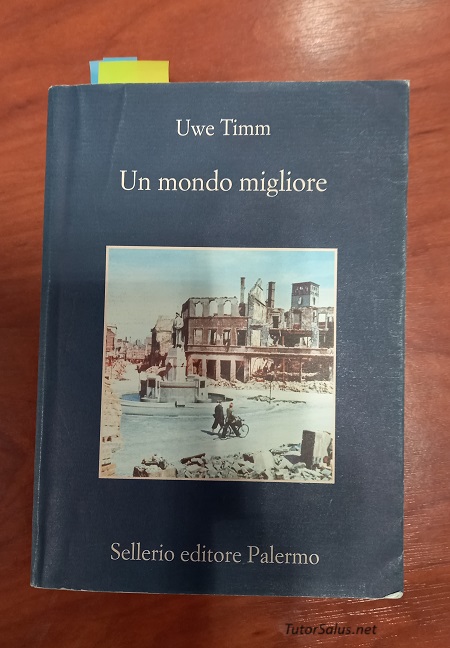
I listened to Uwe Timm[2] who I didn’t know, during his presentation at the ‘Book Pride 2019’ last March the 16th, in Milan : his capacity to reach the individual, in a so crowdy room and without speaking any Italian seemed notable to me.
Nothing obvious in responding his interlocutors – mainly young people, and admirers of his work, clearly sincere – nor any sign of tiredness that might have seemed reasonable on a sultry Saturday afternoon.
There was a beginning, as explained Uwe Timm who remembers little directly about the War because he was born in 1940 : but through his father-in-law, who started out as a socialist and then became a scientist expert in eugenics and euthanasia, Uwe Timm began to wonder what goes on in the mind of a man who begins with ideals of fraternal solidarity and then turn to collaborating for a social community that does not exist, with men and women to be selected according to codified criteria, pledging to fight until the physical elimination of anyone who does not match the established coding…
He began to want to investigate how it could happen that, in those terrible years , so many followed that music and only very few opposed it.
In 1945, lucidly recalled the German writer who was just a few years old at that time, there was a feeling of disgust towards everything that had happened just before, films were screened on the concentration camps : many, everywhere, commented that they would never have imagined anything like this, when their Jewish neighbours were taken away.
And after that initial wave of disgust there was reconstruction, something cathartic that took away the uncomfortable memory along with the rubble.
And after that brisk and vigorous reconstruction, there was the cancellation of everything had happened in the War : the slide from ‘imputability’ to ‘avoidance’ is easy, perversion is called.
Of those frenetic months that followed the occupation of Germany by the United States of America, Uwe Timm remembers with the clear memory of a five-years-old child that suddenly there was an abrupt change, American soldiers even smelled different from German soldiers, on the streets, in the shops, in the offices everyone – everyone – said that they had had to endure the nazism, of having been ‘forced’ to obey ‘against’ their will.
No one even admitted that they had collaborated to obtain ‘a little something’, more or less substantial, that would supplement meager incomes of the time.
Even today - reports a lucid, calm Uwe Timm elegant man of seventy with a refined Alemannic pronunciation - there is a generalized victimization in Germany that makes us think : but then no one was ever a Nazi ?
It’s interesting that the original title of the novel, which arose from the auto-biographical intuition of Timm, is ‘Ikarien’ - that is disceples of ‘Ikaria’ - the utopian community theory of the French founder Etienne Cabet from which the two protagonists, Wagner and Ploetz, come : and ‘Ikaria’ was the ‘commune’ itself, the community then formed in Iowa (U.S.A.) with alternating vicissitudes. The translation, carefully chosen by Matteo Galli for the Italian edition of ‘Sellerio’ is very adequate, ‘Un mondo migliore’ : and leads to the double and opposite meaning of abstract, hateful ‘utopia’ and of constructive, peaceful ‘hope’.
The lemma ‘imputability’ gathers as a matter of fact friends, or enemies : no neutrality.
Marina Bilotta Membretti / Cernusco sul Naviglio – August 30, 2019
TutorSalus.net - Freudian journalism
[1] ‘Un mondo migliore’, by Uwe Timm – 2019 ‘Sellerio editore’ Palermo, p.225
[2] Uwe Timm was born at Hamburg in 1940 : as a writer he has already received a number of awards and reviews, see recently the ‘premio Napoli’ and the ‘premio Mondello’; he is also author of short stories and children’s book, and he also collaborates on radio broadcasts.