Vivian Maier : by chance.
Vivian Maier at Nuoro (2015).
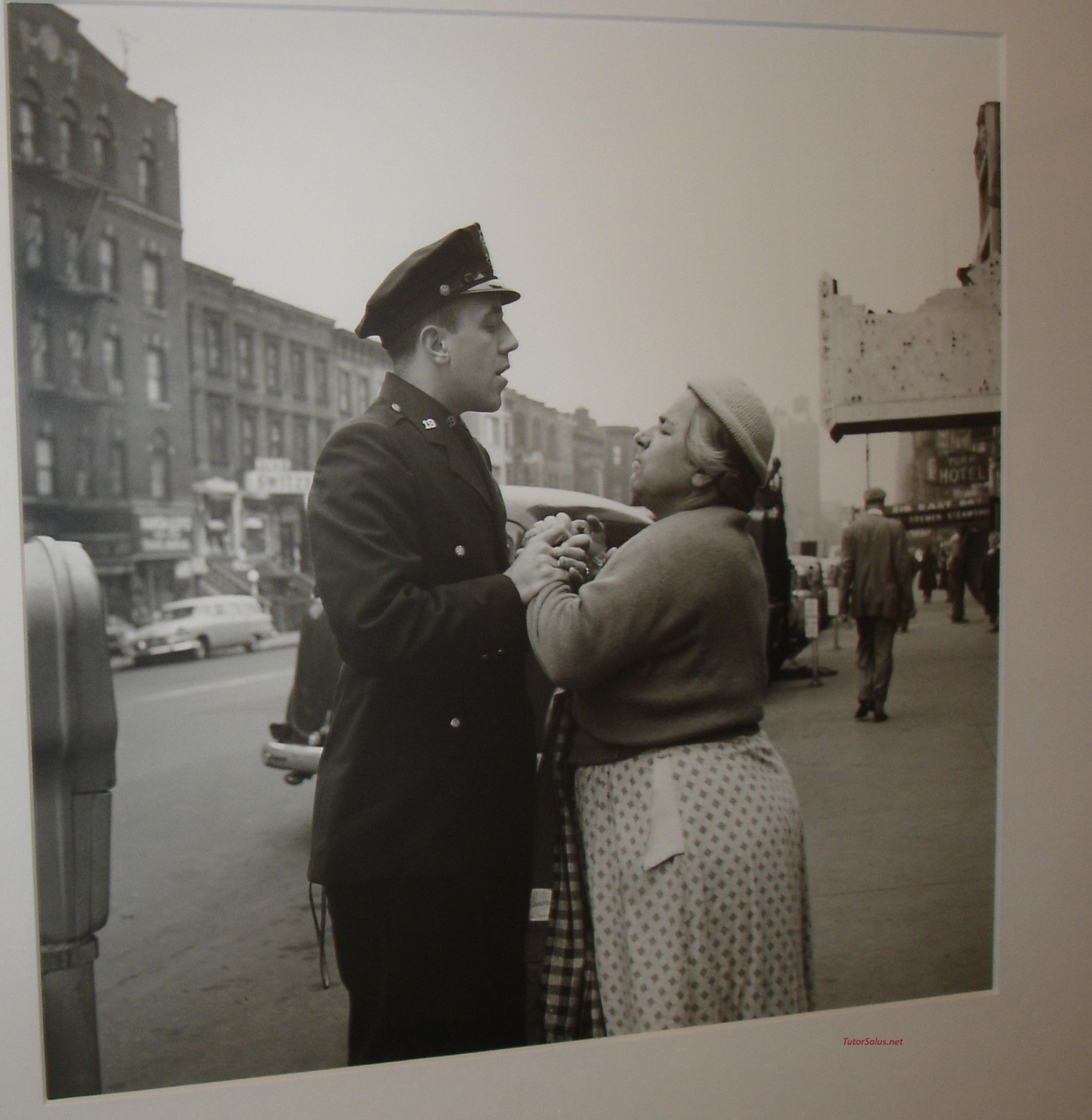
I invite you to know the story of Vivian Maier, who I myself by chance found out about, and then I was able to meet in the beautiful and so far only exhibition set up in Italy, at the MAN Museum[1] in Nuoro, in the elegant building where various exhibitions are housed, also documenting the sober and cultured refinement of 19th century Nuoro.
The exhibition about Vivian Maier’s work unfolds in fact through some rooms with characteristic arched ceilings, connected by the marble staircase on three floors : it offers a rich and selected collection of the incredible quantity of photos taken by the first ‘American woman-street photographer’[2] and found completely by chance by the young and enterprising John Maloof[3] .
Vivian Maier, born in the United States in 1926 and returned as a child in France where her mother’s family lived, then independently came back in the States in 1951, where she immediately looked for a job as ‘nanny’, that is a governess for children in wealthy middle class families. In a number of photos she films the nuns, perhaps not entirely ironically, because in English is written ‘nun’ and pronounced ‘nan’, very close to ‘nanny’ to which Vivian in some way compared herself. But, were indeed enough the stormy emotional events, she almost cinically commented in several photos, of her father and mother to nail her definitively and exclusively to children ?
John Maloof found himself dismayed when faced with an unexpected, enormous quantity of often repeated shots, flashes and kilometers of impressed films, haphazardly piled by Vivian in the trunks of the famouse garage[4] taken over after her death.
Vivian Maier never tried to make public her passion which remained secret even from her employers. They say about her that, in the free time provided for by the employment contract, she could be seen leaving with her ‘Rolleiflex twin-lens reflex’ hanging conspicuously around her neck. And then, seen returning hours later, or after her holiday period has ended, just as she was simply returning to duty : dignified, very tall and silent, with something rigid and absolutely non-sensual in her movements – the children laughed secretly and far away from her, now as adults they admit it.
Vivian Maier’s self-portraits are numerous and often disturbing, almost a first generation selfies to which this Nuoro exhibition dedicates a room. She sends her Rolleiflex forward but the viewer is struck by the difficulty of attributing with certainty to her a sex, and a thinking : boredom, distrust, curiosity ?
Vivian Maier ended up printing very few photos – perhaps for economic reasons, but who knows – and most of these are the result of a very careful work by John Maloof, who exalted their value as well as his own value as a precious tracker of never known artists.
It’s reasonable to assume that Vivian Maier died dissatisfied with the result of her work as a photographer, jealous of every last quintal of film she hid, which not even the employers knew existed, despite having granted her that garage for storage use and that she had begged for her trunks, with a sense of the ridiculous that Vivian herself contributed to being imputed to.
She was unable to convincingly immortalize poverty, the moment in which satisfaction escapes giving in to resignation : yet she had tried in every way. But, despite never attempting new professional paths, with resentment remaining glued to the family where she worked, “… that shot was enough for her…”, as a viewer observes facing with photos which communicate a voyeurism difficult to admit towards prerogatives from which Vivian Maier believed herself excluded.
“Children loved her…”, a visitor woman comments facing with a photo where Vivian holds tightly by the hand the two little children entrusted to her. And they admit, but interviewed today as adults, in a dry tone and respectful of the camera filming them : “She was good…” Today they can finally be grateful to Vivian for something, even just for a brief unexpected success for knowing her as a ‘nanny’.
With an impassive tenacity that slipped into obstinacy, Vivian got to perfection her outfit, the very expensive equipment essential to the ‘street photographer’ of the 1950’s. As she herself soberly confessed, she much preferred the American metropolis with its imbalances, its contrasts, its easy ostentations : she liked the poor and especially their defeats.
Using trains and public transport she traveled elsewhere, but only to take photographs : at the seaside for example, or even abroad, managing to bring the subjects she chose closer than every time, at such a little distance that we can understand how often a serial killer is capable of winning the favour of the chosen victims.
Marina Bilotta Membretti / Cernusco Sul Naviglio – September 27, 2015
TutorSalus.net - Freudian journalism
[1] ‘Vivian Maier – Street photographer’ July 10th – October 18th, 2015 – Museum of Art MAN of Nuoro, Via Sebastiano Satta 27.
[2] ‘Street photography’ is a photographic genre that appeared towards the end of 19th century and until the end of the 1970s when portable machines gradually became established, and intends to shoot public places and subjects in real situations; ‘street’ generally indicates where human activity is visible; framing and timing are key aspects of this photography.
[3] John Maloof (1981, Chicago – Illinois) achieved succes with the documentary – film ‘Finding Vivian Maier’ which was rewarded in 2015 : fond of history and journalism, he began working as a second-han dealer with his father and brother, but John especially revealed remarkable business acumen, indeed admitting that it was his own talent that guided him with confidence in identifying and purchasing Maier’s trunks at a negligible price (380 dollars in 2007), and then transforming Vivian’s pale life into a success.
[4] ‘Finding Vivian Maier’ (2013) is the film directed by John Maloof and Charlie Siskel. John Maloof is also editor of the book ‘Vivian Maier : Street Photographer’ and curator of Vivian Maier’s work.