Architectural implications.
Gae Aulenti[1] and Milan.
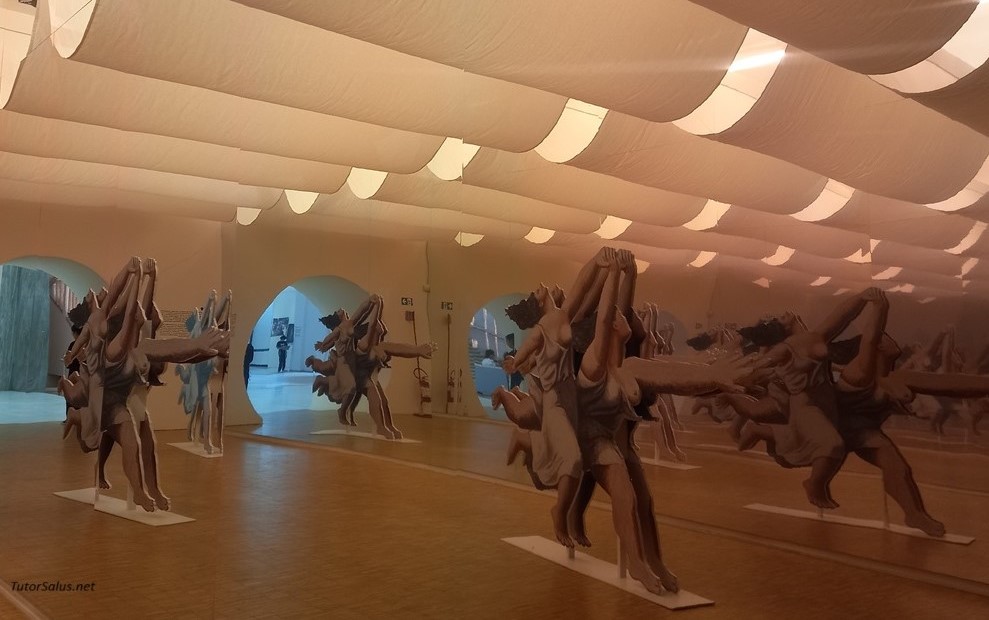
In the photo: ‘Arriving at the seaside’ (taken from ‘Two women run on the beach’ by Picasso, 1922) is Gae Aulenti’s first professional achievement, as she was rewarded in 1964 at the ‘XIII Triennale’ of Milan.
And finally an exhibition[2] in Milan about Gae Aulenti, excellent adopted daughter of this city which she lived willingly in, and honouring it greatly. Today the square that bears her name is the new district of a traditional and central neighbourhood which now has to refer to it : right next, is Piazzale Cadorna redefined by ‘Gae’ in 2000 with the new facade of the Northern Railways Station, and just beyond the ‘Palazzo of Triennale’ which Gae Aulenti has dealt with since 1951 when, still a student at the Polytechnic of Milan, she was already collaborating in the preparation of the Architecture students’ exhibition, and then in 1994 inventing the Drawing Gallery.
In fact, the exhibition opens with her first professional achievement, and precisely at the XIII Triennale of 1964 that rewards Gae Aulenti’s installation, named ‘Arriving at the seaside’ for the room dedicated to Free time, and taken from a polemical Picasso framework of 1922, ‘Two women run on the beach’. ‘Gae’ – as everyone called her - is well aware of a certain distrust[3] that surrounds her, and takes that criticism by Picasso to women, but makes it an opportunity for a costant reflection along her professional path that began as simple graphic designer for ‘Olivetti’ industries at Ivrea. However is at the MOMA[4] of New York in 1972, with the setting she presented at the exposition ‘Italy : the new domestic landscape’ that Gae Aulenti breaks away from the abstractions[5] of Modernism that she calls ‘fiction’[6] to instead indicate its critical issues
“… the hope of reality, which is the only possible key by which to interpret the object, for it serves to eliminate the ambiguities, contradictions, discords, and distortions of our chronicle. The objects with which we generally come into contact are very numerous indeed, they are mostly new, but also precarious and incostant, and at least some of them are doomed to rapid disappearance; some have been seen to appear with possible uses which have up to now never been exploited: they distort behavior, they unleash anxieties and hypnoses, are ready to cause harm to nervous systems and cause casualties in the realm of intellectual adjustment, even criminality.” [7]
Maintaining continuity while avoiding the fractures that the post-war period seemed to forcely demand through the modernist Functionalism, attracts the title of ‘Neo Liberty’ and severe criticism by Bruno Zevi[8] and Reyner Banham[9] to this orientation. But she knows how to gather clients which are increasingly complex and varied, and mainly respectful of her work. Thus, many objects emerge from her atelier, city buildings wherever they are located, houses – first of friends, and then of friends of friends – but above all pieces of cities, showrooms, factories, even costumes and theater scenes, projects already discarded by her senior colleagues which she collects and works on without pain.
“I find that the visitor problem is very little analyzed. I believe that a museum is a place of high pedagogy, where the act of visiting represents real work, both for school children and for specialists. Art doesn’t leave you at peace, doesn’t satisfy. In my opinion, a museum is a provocateur of questions.” [10]
“What are the coordinates of our cities ? What functions constitute the nervous and lymphatic systems, the support of a modern city ?” [11], Gae Aulenti writes in her notes of 1973 after a travel to India.
“The house, the single residential cell… then becomes the place of a family that has now overcome the narrow and obscurantist sense of its own closure, becomes the place of the gained autonomy of young people. So we can describe a cell that can form and reform with maximum flexibility, with maximum interchangeability and maximum possibility of use that is, a space that may or may not be divisible by the inhabitants themselves, by means of elements that can form closed or semi-open spaces, wardrobes or beds, support surfaces for eating or for studyng, shelves for books or for other things. This space is entirely habitable, there are no entrances and little entrances, corridors, ante-rooms and ante-bathrooms, and all those spaces codified by an authoritative vision of family relationships…”[12]
There is investment and hard work to ensure that a space – our own space indeed – presents itself as open and social, but also strong and defended. If even an utopy is thinking of a possible future, however we prefer this thinking to the game. The game is just the narration of a project that doesn’t exist and that in any case leads to the anguish of knowing that it twill not be possible.
The only chance is therefore discovering reality, because it is wealth, fruitfulness, sweet and universal strength.” [13] ‘The yielding house’ by Gae Aulenti is a goal achieved without a lighthearted running and without naivety, not phallic, absolutely new.
Marina Bilotta Membretti / Cernusco sul Naviglio – September 22, 2024
TutorSalus.net - Freudian journalism
[1] Gae Aulenti (1927-2012) designed, cared and realized a great number of works, both of architecture and design and in numerous cities : from Milan to Paris, to Seville and Barcelona, to Venice, Florence, Rome, Tokyo, Palermo, San Francisco and elsewhere. Among the major recognitions she received the Imperial Prize at Tokyo in 1991, and the golden Medal to the Career in 2012.
[2] ‘Gae Aulenti (1927 – 2012)’, at the ‘Triennale di Milano’ 2024, May 22nd – 2025 January 12th. In collaboration with the ‘Archivio Gae Aulenti’.
[3] ‘L’architettura è un mestiere da uomini ma ho sempre fatto finta di nulla’ – Corriere della Sera, 21 febbraio 2011.
[4] ‘The Museum of Modern Art’ – MOMA, 11 West 53 Street, New York.
[5] ‘Fare architettura’, pp. 9-11 in ‘Gae Aulenti. Vedere molto, immaginare molto’, Collana ‘Humana Civilitas’ Edizioni di Comunità Srl 2024.
[6] ‘La scoperta della realtà’, pp. 20-21 in ‘Gae Aulenti. Vedere molto, immaginare molto’, Collana ‘Humana Civilitas’ Edizioni di Comunità Srl 2024.
[7] Taken from: ‘Release no.35 - House environment’, Designer: Gae Aulenti, Patron: ANIC Lanerossi, Producer: Kartell in ‘Italy: the new domestic landscape’ – Director: Emilio Ambasz, May 26th – September 11st, 1972 MOMA New York.
[8] ‘L’andropausa degli architetti moderni italiani’, B. Zevi in ‘Editoriali di architettura’ Einaudi 1979.
[9] ‘Neo Liberty – The Italian retreat from moderne architecture’, R. Banham in ‘Architectural Review’ Londra 1959.
[10] ‘Cinque musei’, p.55 in ‘Gae Aulenti. Vedere molto, immaginare molto’, Collana ‘Humana Civilitas’ Edizioni di Comunità Srl 2024.
[11] ‘La casa arrendevole’, p. 35 in ‘Gae Aulenti. Vedere molto, immaginare molto’, Collana ‘Humana Civilitas’ Edizioni di Comunità Srl 2024.
[12] ‘La casa arrendevole’, pp. 36-37 in ‘Gae Aulenti. Vedere molto, immaginare molto’, Collana ‘Humana Civilitas’ Edizioni di Comunità Srl 2024..
[13] ‘La scoperta della realtà’, p. 25 in ‘Gae Aulenti. Vedere molto, immaginare molto’, Collana ‘Humana Civilitas’ Edizioni di Comunità Srl 2024.