‘Electra’and 'l’Amur'.
Roberto Andò[1] director at the Greek Theater of Siracusa.
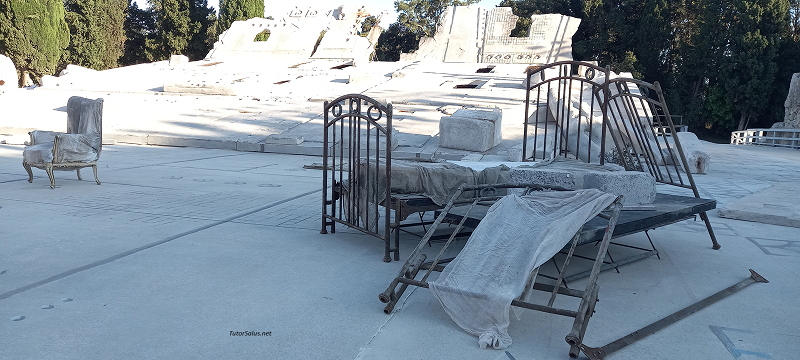
www.indafondazione.org ‘Electra’, by Sophocles (first performance in 410 b.C.) : Direction by Roberto Andò; Translation by Giorgio Ieranò; Scenes and Lights by Gianni Carluccio; Costumes by Daniela Cernigliaro; Music by Giovanni Sollima; Main actors: Sonia Bergamasco, Roberto Latini, Anna Bonaiuto, Rosario Tedesco; Coryphaee: Paola De Crescenzo, Giada Lorusso, Bruna Rossi; Chorus leader: Simonetta Cartìa; With the participation of the students of the ‘Accademia d’Arte del Dramma Antico’ of Siracusa.
Is the parental bed still a conjugal bed ? Electra can’t make up her mind…
But here, of the matrimonial passion – that can only be guessed from the nobility of the initial structure - nothing remains but the ruin of a wrecked, rusty, dusty bed: yet this was exactly what it was, even for her regal parents Agamemnon and Clytemnestra, their marital bed. Desirable, then?
That double bed is Electra’ desperation and her breathlessness, with no other power than to barely touch it, even in a frantic attempt to climb onto it. Electra the shining lady[2], she who attracts with her brightness, here instead dresses the penitent’s sackcloth and ashes: worn rags and waveless hair, hers is the colour of the sand that slips away, not the red of the flame nor the black of the night.
Orestes, the little brother indebted to Electra – a debt that can never be sufficiently repaid – for being saved from death as the only intended male heir, just after the Agamemnon father’s murder, now is a man: Orestes had already detached himself from that parental bed, he is planning a new life, the scepter of Power a cumbersome phallus and not his own.
But That is exactly what Electra is missing, and in all its burdens : her confused and suffering mind does not stops ominous glares and flashes, her laments and her so gray existence indicate and demand sacrifice, attracting affections and fatal bonds to her.
“…Is this really Electra’s famous look ?”[3]
“…This is it, yes.”[4]
“Seeing you overwhelmed by so much suffering…”[5]
“…And with all sort of mistreatment.”[6]
Sophocles is not surely naive, and Roberto Andò takes care of a direction where the good Sonia Bergamasco will never expose Electra to her manipulative responsibilities – but the gods and Fate do not attribute them to her – towards the poor Orestes[7]: who, defeated by the persecution of ‘l’Amur’[8] which never is love, tragically gives in to that one-track mind which is his naive affection for the imploring sister.
And it is Orestes, fully aware, who carries out the double crime which Electra wanted.
Marina Bilotta Membretti / Cernusco sul Naviglio – September 22, 2025
TutorSalus.net - Freudian journalism
[1] Roberto Andò was born in Palermo in 1959, he met and frequented Leonardo Sciascia before arriving at journalism and cinema where he began as assistant of the director Francesco Rosi and then of Federico Fellini, Michael Cimino, Francis Ford Coppola until his debut as a theater director in 1986; between 1990 and 1995 he has been the artistic director of the 'Orestiadi' in Gibellina, Sicily; the first feature film, 'Diario senza date' (1995), presented at the Venice Film Festival, was appreciated by the director Giuseppe Tornatore, who introduced him to a true cinematic debut with 'Il manoscritto del Principe' (1999), which focused on the final years of writer Giuseppe Tomasi di Lampedusa's life, the film was awarded with the Nastro d'Argento as best production: from this moment, Roberto Andò alternated an intense activity of both theatrical and cinematic direction, alongside the publication of novel-essays ('Diario senza nome', 2008; 'Il trono vuoto', Campiello Prize 2012); in 2022 he directed the film 'La stranezza' about Luigi Pirandello, starring Toni Servillo and 'Ficarra e Picone', and in 2025 the film 'L'abbaglio' about an episode of the war of liberation by Garibaldi, again with the participation of Toni Servillo and 'Ficarra e Picone'.
[2] The etymology of Electra is in fact ‘shining, bright’.
[3] Cited from Orestes, line 1177 – p. 159 in ‘Il mito di Elettra, a cura di O. Piscini' – Soc. editrice Dante Alighieri (2009).
[4] Cited from Electra, line 1178 – p. 159 in ‘Il mito di Elettra, a cura di O. Piscini' – Soc. editrice Dante Alighieri (2009).
[5] Cited from Orestes, line 1187 – p. 161
[6] Cited from Electra, line 1196 – p.162
[7] An excellent, surprising Roberto Latini.
[8] J. Lacan, ‘Il seminario - Lib. XX Ancora 1972 - 1973’, Text established by Jacques-Alain Miller, Italian edition by Antonio di Ciaccia / Piccola Biblioteca Einaudi (2011), Chapter 1 - page 6