Acknowledgements.
Astrid Lindgren and his firstborn Lars.
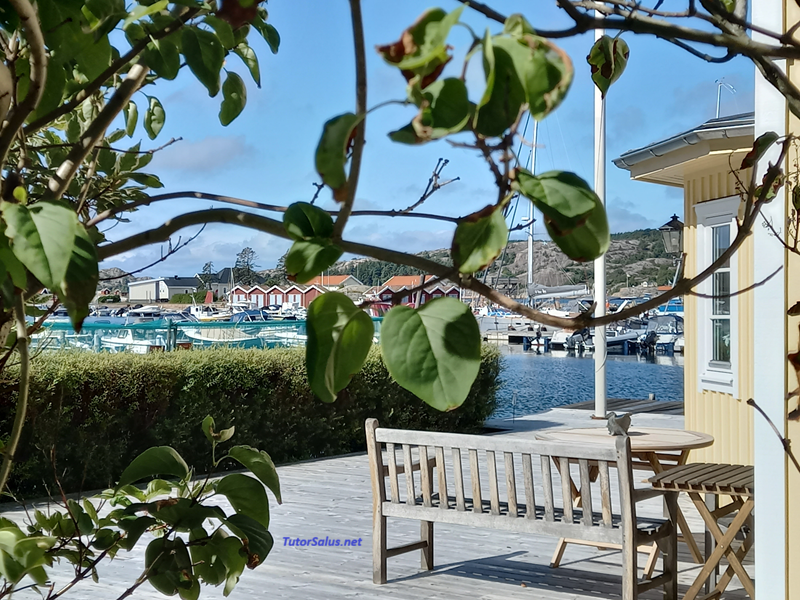
In the photo: a corner of Fjällbacka in southern Sweden, an outpost of the beautiful ‘Weather Islands’ archipelago (Väderöarna). It is dominated by the mountain Vetteberget that has been split into two peaks since the Ice Age, one of which is nicknamed 'The Wolf's Throat' (Vargklämman) in honour of the story ‘Ronja, the Robber’s Daughter’ by author Astrid Lindgren.
Books to work on/ 9.
Astrid Lindgren[1] also wrote a brief, isolated short story concerning perhaps the darkest period of her life. 'Mio, min Mio’[2] is the narration of a presumed lack—the Theory of a lack, that is – but merged in the pain of a guilt which is never really a guilt, and yet fears the truth.
Stepping into the story—held tight by an atrocious, unspeakable affection – Astrid makes the child-character say what her own anguished imagination suggested to her as a young single mother in the early 1900s, in a tiny village of a matriarchal Sweden.
Astrid had experienced a 'lighthearted' childhood – as she named it in her maturity – deliberately far from the reality of the ongoing war, as her parents had wished. She was rudely awakened from this deception and, when she found herself pregnant with a child whom the wealthy father would not have recognized, decided to move to Copenhagen. In that decent city, she was able to face the birth that her fellow villagers had made so difficult for her.
In Copenhagen in fact the young mother made a good friend—a colleague at her new library job, of the same age and married: Elsa had also a child just slightly older than little Lars, and the family welcomed Astrid’s baby warmly while she sought peace and stability. It may be difficult to admit, but 'little' Lars was very happy during those first years of life in his new family, with a near-twin brother, two moms, and an affectionate dad.
It was conscience, then, to intervene: because Astrid hadn’t stopped dreaming of 'le-nom-du-père'[3] for 'her' Lars—also according her Motherland’s Law, so civilized and inflexible. When Astrid finally met the man she would sincerely marry, he was also willing to welcome a son already born: Lars instead suffered immensely from that forced, unfair, arbitrary moving from which he never truly recovered, even as an adult.
Why not conveniently grow that asymmetrical family which was going strong, but which the same adults - so intelligent in the time before – now tried to clumsily diminish?
As a matter of fact Lars's voice did not reach the adults with equal strength, nor, perhaps, did he look for it further himself.
Instead he, reaching out from that 'lack' that leaves no escape, even took it upon himself to protect his mother's publishing rights. [4]
Marina Bilotta Membretti/ Cernusco sul Naviglio – February 13, 2026
TutorSalus.net - Freudian journalism
[1] Astrid Lindgren (1907 - 2002) was born in Vimmerby, southern Sweden, and spent her childhood on the family farm in a peaceful and 'lighthearted' - as she herself named it in her maturity - environment . She began working very young as a proof-reader, and then in the local newspaper: at eighteen she realized she was expecting a child, but the father, who was also her employer, refused to acknowledge him. So Astrid moved to Copenhagen where her firstborn Lars was born in 1926: she could entrust the baby to the family of her friend Elsa, who was married and already a mother of a child, while Astrid was working in the city. When the financial difficulties of the move were overcome, in 1931 Astrid married Sture Lindgren, who gave his surname to Lars. Karin was born in 1934, and while Astrid was taking care of her she also invented the adventures of the girl 'Pippi Longstocking' (Pippi Långstrump), which began to be published starting from 1945, and also successfully translated into many languages, even adapted into television series: while Astrid continued to work in children's publishing, also venturing into 'crime' novels. She received many honours and awards: the ‘Hans Christian Andersen Award’ (1958), the ‘Lewis Carrol Shef Award’ (1973), the ‘International Book Award’ from UNESCO (1993), the ‘Right Livelihood Award’ (it is made similar to the Nobel Award for children’s literature, 1997). In 1997 she was also named Swedish person of the year.
[2] Written in 1954 when her son Lars was already an adult and Astrid Lindgren was perhaps in the most productive years of her career, 'Mio, min Mio' remains a unique and singular story among the author's works, not only for the direct biographical theme involving both Astrid and Lars, but also for a melancholic style that was not entirely congenial to her/ Adriano Salani Editore s.u.r.l. (2025), translation into Italian by Alessandro Storti, illustrations by Johan Egerkrans.
[3] Preceded by ‘The Mirror Stage as Formative of the Function of the ‘I’’ (‘Communication given at the XVI International Congress of Psychoanalysis’ – Zurich, July 17, 1949) and then by the Lesson ‘The Purloined Letter’ on April 26, 1955 ('Jacques Lacan. Scritti', Vol I, a cura di Giacomo B. Contri - Giulio Einaudi SpA 1974 e 2002) inside the Seminar Book II by J. Lacan 1954 1955, the expression ‘Le Nom-Du-Père' (The Name of the Father) was introduced by J. Lacan on January 15, 1958 in the Seminar Book V ‘The Formations of the Unconscious’ (translat. into Italian by Antonio Di Ciaccia and Maria Bolgiani, Giulio Einaudi editore SpA - 2004).
[4] Lars Lindgren (1926-1986) had studied to be an engineer, but from 1968 to 1986 he managed the company 'Tre Lindgren AB', which handled Astrid Lindgren’ publishing rights.