Law to occur.
‘La grazia’ [1], by Paolo Sorrentino[2].
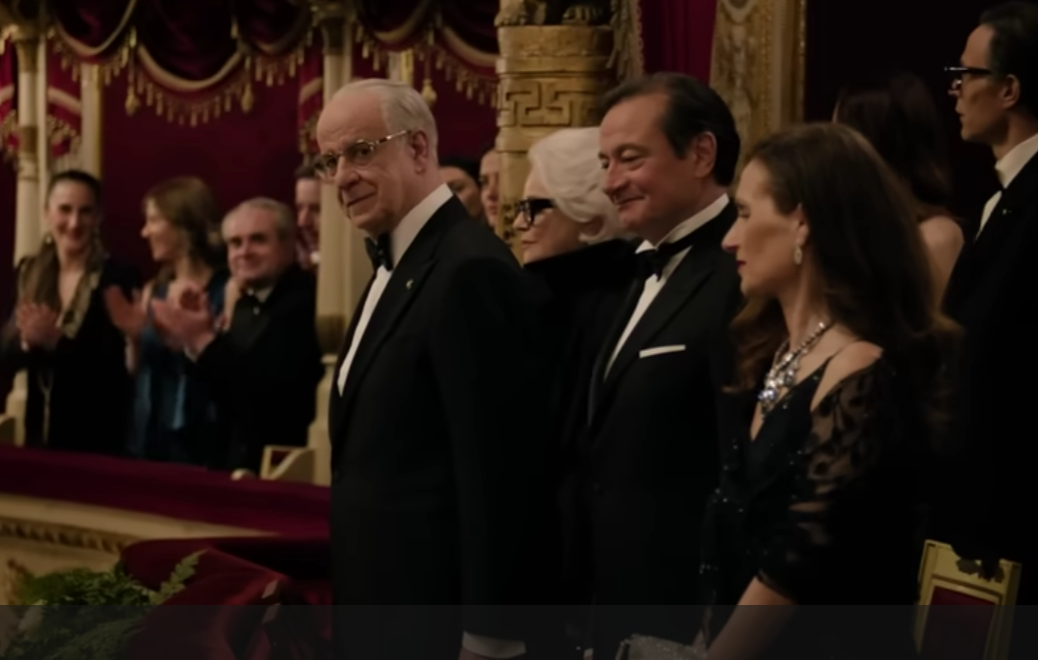
In the photo: screenshot shared from the trailer of ‘La grazia’, by Paolo Sorrentino.
It is in the awakening from a nightly dream that we realize we have the right to gather that dream because it all holds together: and it would be a good start every time.
Paolo Sorrentino, listening to him, yields to melencholy: a fairly ordinary, yet ineffective, defense for those who shun common arrogance, and perhaps have had to pay the price for it. Any dream, however strong and even three-dimensional it may be, is never arrogant and fades easily - we know it - but the message remains etched in our mind, like the blueprint of a sculpture.
Mariano De Santis “never dreams, but he would very much like to...”: he lacks the courage to admit that he can't wait to become Senator for life, a succession automatically[3] foreseen for those who have been President of the Italian Republic: he is the institution and defender of the Constitution, that is, with powers placed at the summit of those (legislative, executive and defense, judicial)[4] of governing: It is a responsibility that others would face with the gay lightheartedness of obtuseness, but which requires from the protagonist a daily "diligence of a good father"[5] that bends and sets one to work. Not at all, mainly, a matter of gender.
“To whom do our days belong?” his daughter often asks him: but the man sculpted by Paolo Sorrentino does not like rhetoric, unlike the nightly dream. Instead, where to start? Good question.
And the man brace himself - he knows how irreplaceable - in the law: or rather, a grace.
Marina Bilotta Membretti/ Cernusco sul Naviglio - March 12, 2026
TutorSalus.net - Freudian journalism
[1] Presented as opening film at the ‘Mostra internazionale d’arte cinematografica di Venezia’ 2025, ‘La grazia’ has been directed and co-produced by Paolo Sorrentino.
[2] Paolo Sorrentino (1970) is an Italian director, screenwriter, novelist and film producer: ‘Le conseguenze dell’amore’ (2004); ‘Il divo’ (2008) which received the Jury prize at the Cannes Film Festival; ‘La grande bellezza’ (2013), which obtained the Academy Award and the Golden Globe as the best foreign film, and four European Film Awards: ‘Loro’ (2018); ‘E’ stata la mano di Dio’ (2021); ‘La grazia’ (2025) are among his most significant works. In 2010 he published his first novel ‘Hanno tutti ragione’, and in 2015 he received an honorary degree in ‘Filologia Moderna’ from the ‘Università Federico II’ of Naples.
[3] Art. 59 paragr. 1, from the Constitution of the Italian Republic.
[4] Art. 87 mainly, from the Constitution of the Italian Republic.
[5] Art. 1176 of the Civil code.