Justifying.
Between man and animals.
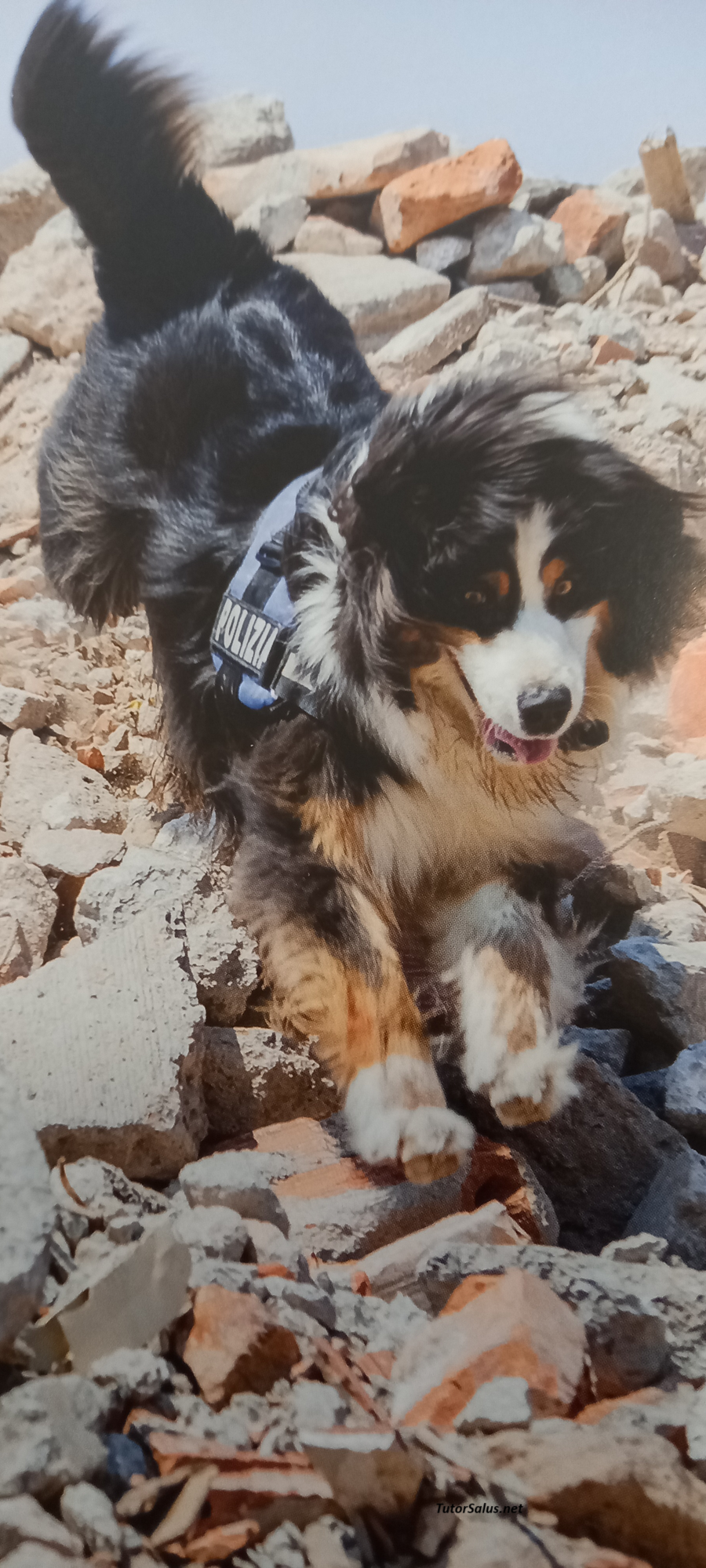
In the photo: ‘Night spirit’ is an Australian Shepherd employed by the Italian State Police; at 4 months he began the trial with the so called ‘gentle method’, in the total absence of coercion, reproaches, punishments; at only 10 months he positively passed the challenge aptitude exam, qualifying himself as a ‘rescue, surface and under the rubble search dog’ at the State Police Dog Center of Nettuno (Italy). ‘Night spirit, Un campanello di speranza’, pg. 63. Taken from ‘Cani & eroi. Storie di poliziotti dal fiuto speciale’ (2019/I.P.Z.S. SpA), Introduction by Franco Gabrielli-Head of Italian State Police and General Director of Italian Public Security, Preface by Alberto Angela-paleontologist and TV journalist.
“In reality the reasons why we can like with such singular intensity an animal like Topsy (or Jofy), are sympathy without ambivalence, making life easier – as it is freed from the conflict difficult to bear with civilization –, the beauty of an existence accomplished as a whole. And, notwithstanding the heterogeneity of the organic growth, the feeling of a close kinship, of an undeniable affinity. Often, when petting Jofy, I caught myself mumbling a melody which I, an absolutely non-musical man, had to recognize as the ‘aria’ of friendship in ‘Don Giovanni[1]’.”[2]
To benefit from one’s calling[3]/45.
Even comparing different translations, it is evident Freud’ intention to place a justification between man and animals, in this specific case the dog. When saying “making life easier – as it is freed from the conflict difficult to bear with civilization” -, Freud recognizes the not-existence of istinct for men, who from reality are continuously urged to work for interpreting it, unlike genetical simplification of istinct which directly dictates to animals, limiting them to exclusively look after to the dictation and without posing conflicts.
In this regard a recent ruling will make you think about, as it was resolved with the acquittal of the son – at the time eighteen-year-old, now twentythree-year-old – once again accused in the Appeal of killing his father during a further attack on the mother, in presence of the brother of the accused. The ruling will make you think about because theme was a crucial issue, with precedent and extensive jurisprudence: the issue of a real ‘self-defense’ that this very painful case allowed us to delve deeper putting on trial the capacity[4] – exclusive category of thinking – which is capacity by the accused to interpret reality, rather than ‘interpretive vulnerability’[5] as previously assumed.
“I answer that I was only focused on going ahead of my father in picking up a knife…”[6], the young man accused would finally admit, thereby indicating the objective human impossibility to deal with more than one emergency at the same time, and also introducing the ‘non-automaticity’ of the defense, even in situations of grave threat and mortal danger : any human defense cannot be istinctive indeed, because it comes from an individual interpretation which animals are not allowed to enjoy.
Freud’ conclusion remains ultimately extraordinary because, as going so far as to blame himself, he connected istinctive naivety of animals to a two-edged emotion of men towards those, as in the cited “aria of friendship” in Mozart, who do not recognize the betrayal : the temptation to give up thinking, from which no one can consider themselves exempted, is only human as a matter of fact.
Marina Bilotta Membretti / Cernusco sul Naviglio – February 22, 2025
TutorSalus.net - Freudian journalism
[1] ‘Don Giovanni’ (1787), W. A. Mozart - Act II Scene 10.
[2] Cited from: 'To Marie Bonaparte' (1936) in ‘Epistolari. Lettere alla fidanzata e ad altri corrispondenti, 1873-1939’, S. Freud/ Bollati Boringhieri (1990).
[3] www.tutorsalus.net/index.php/en/pensare-da-partner-2/358-psychoanalyst-and-profession-1
[4] See the previous ‘Sentenza 26 – 13.12.2023’ R.G.4/22 – N.R. 7948/2020, I Sez. Corte d’Assise di Appello di Torino, p.19
[5] Cited from the previous ‘Sentenza 26 – 13.12.2023’ R.G.4/22 – N.R. 7948/2020, I Sez. Corte d’Assise di Appello di Torino, p.17
[6] Cited from the previous ‘Sentenza 26 – 13.12.2023’ R.G.4/22 – N.R. 7948/2020, I Sez. Corte d’Assise di Appello di Torino p.16