“Persepolis”.
From ‘souff(e)rance’ a ‘douleur’ ??
In an excellent ‘Séminaire’[1] by Jacques Lacan, the famous Parisian psychoanalyst and passionate follower of Freud pointed out a clever game of the unconscious. He showed how the absence or presence of a single letter in a word can bring together or keep apart two meanings that do not exactly resemble each other. The word in question was ‘souffrance’, which the French language translates as 'transit' or 'storage', commonly used in postal services and correspondence.
However, the simple inserting an 'e', changes everything: et voilà! That word becomes soufferance, a suspended tension waiting for a solution, which effectively describes what Freud meant by 'urge'.
Therefore, soufferance would not have a pre-judged destiny toward la douleur (i.e. ‘pain’). if it maintains the quality of ‘souffrance’ - that is, of a 'temporary' storage, a 'transit' in the processing of a satisfactory solution. This solution cannot logically be melancholic or narcissistic as well, even though it often results in being socially compassionate, causing an 'emerging damage'[2].
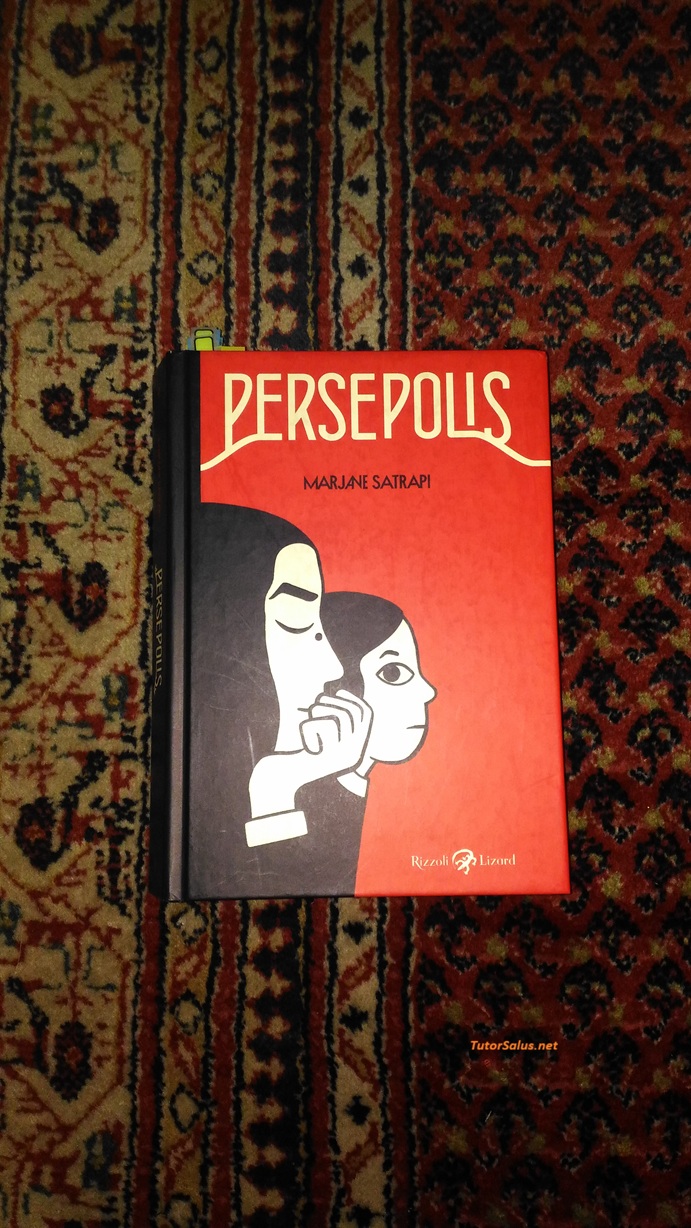
I find myself, then, sincerely thanking Marjane Satrapi for her remarkable ‘Persepolis’[3], a ‘first’ work written in the first person for the 'first' Iranian graphic novel. The simple drawings are deeply expressive and beautifully set, while the prose is effective and, above all, uncompromising.
The surprising cover already reveals something of a powerful message. In the foreground is the profile of a young woman with closed eyes and a large mole on the side of her nose. In the background, a little girl looks at the reader with wide-open eyes, lacking that mole which Marjane explains appeared precisely during her transformation from an adolescent into a woman, alongside a significant growth in height.
Marjane Satrapi says very little about the choice of the title, ‘Persepolis’, dedicating a rather obscure chapter and just a few scattered hints throughout the narrative to it. Translated from ancient Greek, Persepolis simply means 'city of Persia.' However, it was the second of the five ancient capitals following Pasargadae (and alongside Babylon, Susa, and Ecbatana). It was founded around 515 b.C., 1700 meters above the level of the sea, and about fifty kilometers north of the modern city of Shiraz in the Fars province of Iran.
The history of Persepolis, which Darius turned into the splendid capital of Persia with palaces and terraces, is linked to the mythical 'Jamshid the Radiant.' In the ancient Avestan language, Jam-Shid results from the union of two names and is today a widespread male name. He gives the name 'Throne of Jamshid' to the site where the magnificent remains of Persepolis still stand. Zoroastrian writings state that he was the ruler of an ancient dynasty who received a ring to seal and an inlaid dagger, both of gold, from the 'Omniscient Creator' to bring His law to Earth. One could say that in this mythology, the alliance—even a marital one—with the human, patiently sought by the 'Omniscient Creator,' exists exclusively thanks to an intelligent capacity for 'work' that characterizes men and women on Earth.
"In Greek mythology, heroes are predestined, whereas in 'our' myth, the concept of 'fate' does not exist...", explains the Iranian scholar interviewed by Marjane[4] in the book when she was working with her husband Reza on a project commissioned by the University of Tehran.
As the pages of ‘Persepolis’ turn, the choice of that title finds validation in Marjane’s vicissitudes. She begins with a protected childhood where, as the daughter of progressive, wealthy parents of noble origin, she discovers the dark spots of an ancient, complex, and self-referential culture. Is it normal, ten-year-old Marjane wonders, to blame children for the sins of their fathers? Is it normal to be served at home by a peer because she was sold by 'poor' parents as a family maid? Is it normal to accept that belonging to a social class is socially discriminatory? Marjane considers herself "...born with religion" and as a child often finds herself talking directly to God, "...sure of being the last of the prophets." [5] The resemblance to 'The Radiant' is truly striking.
Then come the years of the Khomeinist dictatorship with its fierce repressions and limitations. If her parents opposed the Shah[6], they cannot support a fundamentalist culture that forbids any initiative and individuality, leading them to decide what other families were already doing: sending their children abroad. In 1984, Marjane leaves for Vienna, where she stays for four years, completing the studies that would have been forbidden to her in Iran, but meeting peers, families, and institutions for which she is unprepared, despite being intelligent and cultured. "I pretended to join in, but I didn't inhale the smoke...", "...then I simulated wild laughter, I was quite credible", "I even went so far as to deny my nationality." [7]
Returning to Iran, she finds the country's repressive atmosphere even more suffocating. Yet, with great determination, she decides: "From today on, I want to change my life..." She meets Reza, with whom she prepares for and passes the 'National Exam' required for the admission to University. One day in the city, to avoid one of the frequent checkpoints of the 'Guardians of the Revolution,' Marjane falsely accuses an innocent bystander of harassment, leading to his arrest. However, she admits that due to the regime, 'public conduct' and 'private conduct' were poles apart. [8]
She then decides to marry Reza, but recalls that by the time she found herself in their marital apartment, she already 'regretted' it.[9] Perhaps for this reason—and despite his lucidity in admitting the 'social pressures' capable of cracking a relationship[10]—she decides to divorce three years later and move to France. There, at twenty-six, she begins her promising career as a cartoonist, precisely thanks to the success of ‘Persepolis’—an engaging, limpid narrative without conclusions about a resistance to the 'new,' in front of which cultural archetypes remain a wall for those who use them.
Marjane admits in the final pages[11] that "When problems are no longer acceptable, the only way to bear the unbearable is to laugh at it..."
But 'work' is either conclusive, or it is nothing. Laughing at it—meaning trivializing it—sounds like a jarring contradiction to that splendid, yet marble ‘Persepolis’, historically founded to seal the divine question to humanity throughout the centuries.
Marina Bilotta Membretti/ Cernusco sul Naviglio – May 1, 2020
TutorSalus.net – Freudian journalism
[1] “Il seminario su ‘La lettera rubata’” in “Jacques Lacan. Scritti” Vol. I edited by Giacomo B.Contri, ‘Giulio Einaudi editore SpA’ 2002 / pagg.27-30
[2] ‘Emerging damage’ together with ‘ceasing profit’ and ‘not emerging profit’, is one of the three configurations of the psychopathological diseconomy in “Un uomo che ha domani”, by Giacomo B. Contri / pag.19, see ‘Opera omnia’ 2015 – ‘Sez. Saggi, testi pro-manuscripto’.
[3] ‘Persepolis’, by Marjane Satrapi/ ‘Rizzoli Lizard’ – Mondadori Libri SpA / 12° edition 2019 (original title ‘Persepolis. Histoire d’une femme insoumise’) was given to me by Laura Santalucia, Federica Membretti, Marco Membretti whom I especially thank for the work they have invited me to do with this substantial autobiography.
[4] ‘Persepolis’, cited p. 337
[5] ‘Persepolis’, cited p. 8
[6] Mohammad Reza Pahlevi was the last Shah of Persia until the Islamic Revolution of 1979 : he abandoned his Country and fled to Egypt where he found asylum.
[7] ‘Persepolis’, cited, p.198-201
[8] ‘Persepolis’, cited, pp.294-295, p.314
[9] ‘Persepolis’, cited, p.326
[10] ‘Persepolis’, cited, p. 347
[11] ‘Persepolis’, cited, p. 275