

Intuition, project, reality.
How a company is born: conversation with Christian Loor Loor.
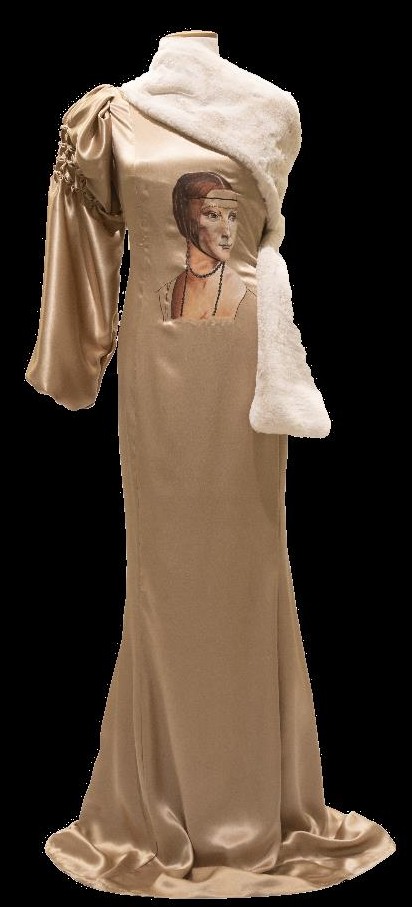
The outfit I chose to introduce the interview with Christian Loor Loor is “The Lady with an Ermine,” created by the tailoring workshop ‘Catena in movimento’ inside the ‘Milan Bollate 2nd Correctional House.’ It was made for the exhibition ‘Leonardo prigioniero del volo’ (Leonardo, Prisoner of Flight) — www.leonardoprigionierodelvolo.com — recently presented at Palazzo Morando in Milan, featuring collaborations with ‘Il Teatro della Moda’, Industrie Ratti SpA, the Municipality of Milan, and established designers. The thirty garments will remain for sale via public auction until the end of March 2020: the proceeds will be donated to V.I.D.A.S. for the first pediatric Hospice in Lombardy.
Here is the description of the gown presented at Palazzo Morando:
“…This work struck me for the naturalness and delicacy it manages to convey—qualities that go beyond mere beauty. Cecilia Gallerani, the subject of the Master’s painting, was the daughter of a very wealthy Milanese nobleman. Taking her as my muse, I wanted to pay tribute both to the beauty of Milanese women and to Milan itself, the city hosting this exhibition and where Leonardo worked.
From a technical standpoint, I designed a very simple dress, following a long mermaid cut with a semi-bell shape at the bottom. My choice was made to emphasize the female form. I also designed a neckline that is open on one side, while the other features a protruding sleeve with details created through fabric manipulation and semi-precious stone embroidery. The ermine wraps all around the body of the dress, just like in the painting. The face of the Lady was painted on the front of the garment.
The fabric I chose for this dress is a very delicate silk in a shiny gold tone. The ermine was created in a darker shade using faux fur. For the creation of this gown, I chose to collaborate with the artists of the ‘Artemisia Workshop’, who were responsible for painting the lady’s face onto the fabric.”
The idea for this interview was born after a conversation with Christian Loor Loor, who offered to guide me through Palazzo Morando among the garments created and exhibited for ‘Leonardo prigioniero del volo’ exhibition. He explained the origins of this project and the extraordinary collaboration that emerged between the young inmates of the ‘Milan Bollate 2nd Prison House,’ the students of ‘Il Teatro della Moda’, and established fashion designers who wished to participate. The project was the brainchild of Christian Loor Loor, who presented the proposal to Dr. Simona Gallo, a legal-pedagogical officer appointed by the Ministry of Justice at the ‘Milan Bollate 2nd Prison House.’ Thanks to Simona Gallo, his proposal received the necessary authorization to begin implementation. Acting as the director and true ‘behind-the-scenes’ choreographer of the project—as often happens in reality too - Christian Loor Loor involved his fellow inmates from the tailoring workshop he had already started for ‘Catena in movimento’ group (Chain in Motion). This initiative was launched by several inmates at ‘Milano-Bollate Prison’ as part of the ‘Restorative Justice’ framework provided by the Italian legal system. Christian also successfully secured external collaborations, including educational support from ‘Il Teatro della Moda’, the contribution of ‘Industrie Ratti Spa’, which provided textiles and fabrics to the tailoring workshop, the patronage of the Municipality of Milan, and the hospitality of Palazzo Morando. The result is a refined exhibition involving many social partners, which aims to support - through the proceeds of a public auction of the garments - the first pediatric Hospice in Lombardia, commissioned by V.I.D.A.S., a non-profit organization providing free assistance to the terminally ill patients.
Q. How was the title of the exhibition, ‘Leonardo, Prisoner of Flight’, born?
C.L.L. First of all, thank you for the attention shown by the public and by those who came to visit the exhibition; ours was an effort of nearly 140 people, and surely each of these individuals has rich experiences to tell regarding their commitment to the realization of the project.
We are a group - a football team, I’d say - and our ‘Manager’ is Dr. Simona Gallo. Together, we chose to name the project ‘Leonardo, prigioniero del volo’ because we find a direct connection between us ‘inmates’ - as subjects in a state of detention, secluded, locked up, etc. - and Leonardo da Vinci with his dream, almost an obsession, of ‘flying’. In our experience, from the very first moment a person is arrested and placed in detention, we have only one recurring thinking constantly in our head: "To have wings and fly." This phase of detention, in which we all desire to fly out of the cell through the bars, is very long and stays with us for years. Furthermore, we imagined the life of Leonardo da Vinci immersed in the constant search for the possibility and dynamics of flying; his life seemed to us almost lived as a form of imprisonment.
Q. What role does creative activity – I mean music, painting, dance, poetry, embroidery, and more - play in your daily life? Does it distract and distance you from reality, or does it help you to live better? And how?
C.L.L. I can tell you about the activities that we, as Catena in Movimento’ group, carried out specifically for this project. For me, sewing and embroidery within the prison context can be compared to the poetic narrative of Penelope. That is, I see myself and my group mates as the ‘Penelope-men of Bollate Prison’. Certainly, when we dedicate hours, days, weeks, and months to this activity provides us with distracting, and in a certain way, we manage to cheat time, just as Penelope did in Ulysses' Odyssey. Perhaps, however, we do not realize all the richness that this experience leaves us with… There are those who learn something new, those who discover a hidden passion; there are exchanges of ideas, interactions between us, and comparisons with realities external to our own. There are dynamics we must impose upon ourselves, such as commitment and discipline, in order to achieve results. There are mistakes and errors that allow us to humbly accept and understand our resources, our limits, and our weaknesses—and above all, what we must do individually, and as a group, to improve or to reach our goals. The project of 'Catena in Movimento' - launched thanks to the commitment of the ‘Milano-Bollate 2nd House of Detention’ and specifically of Dr. Simona Gallo, our coordinator and contact person - gives us the opportunity to put these dynamics into action. All this is part of the re-education and treatment program, offering us new resources for our reintegration into daily relationships outside of detention.
Q. What place does silence have in your daily life? Does it help in your work, or not?
C.L.L. Silence is poetry. The narrative of this project is poetic: when you ask me about silence, I think with nostalgia of the moments when I observed all my companions, as if in a choral dance, each dedicated to their specific action to create garments inspired by Leonardo da Vinci. For us ‘inmates’, silence is necessary, even if, unfortunately, we always have something to say: perhaps it is our suffering, or our dissatisfaction with what is happening, the feeling of not being in conformity with everything that occurs. Therefore, we need to ‘manifest’ and almost ‘scream’ our thoughts and our emotions (I speak for myself and for my groupmates). Every human being finds one’s own system, channel, or method of self-expression; we are a human chain that, together, has something to say: our ‘motto’ is to make a difference. We want to be inmates who make a difference (in a good sense), a difference in our own lives and in the general history of the prison system. We started here in Bollate, but wishing to be replicated everywhere.
Q: Which talents do you recognize as yours, even those coming from the past? Have you discovered new talents now? How are you investing in, or using them?
C.L.L. When I entered prison, on January 25, 2012, from the very first moment I said to myself: "I must turn this situation into a rich and extraordinary experience," without imagining I would remain inside for all these years. I come from a school of acting and theater; I am a playwright and theater director: therefore, since I was a child, I have been searching for the new and for the unknown, regarding human beings and our society. Living experiences from which I can create something is a vital necessity; I could not live if I could not create. These eight years of detention have been incredibly rich in experiences; it has been the most productive season of my life as a human being: I have sown, and I have harvested extraordinary yields. I had the opportunity to take my ‘I’ apart, piece by piece, and I rebuilt it again; unfortunately, I have become a giant. Now I am no longer ‘I’. I am ‘we’, and I like it better - this is the talent I discovered in prison.
Q: In the exhibition, there was a very beautiful dress with embroidered wheels applied to it: does the work of preparing such elegant clothes also affect the representation of yourself ? And how ?
C.L.L. This dress is inspired by the mechanical gear system which Leonardo da Vinci invented; our groupmate chose it as the subject of inspiration to create the dress you are talking about. Our group mate, who chose it as the inspiration for the garment you are telling me about, found a philosophical connection between ‘the gears’ and the state of detention, as well as the rehabilitation program outside the prison walls. He saw himself in the movement of the gear wheels: he noted how one small wheel pushes the others, creating a continuous motion. For the author of this artwork, each of us has gears, in a representative sense, and it is these small wheels that set in motion our actions building a re-education path.
"Each of us has gears..." is a fruitful beginning in any real individual work - profitable, that is - which the choice of a partner either fosters or corrupts. The freedom of fliying begins, in my opinion, right here: the mill of ideas is, in fact, ‘I’.
Marina Bilotta Membretti/ Cernusco sul Naviglio – March 21, 2020
TutorSalus.net - Freudian journalism
To explore the impact of these initiatives further, you can read about the rehabilitation models at the ‘2° Casa di Reclusione di Milano – Bollate’ on the official ‘Ministero della Giustizia’ website, or learn about the creative social projects hosted by the Cooperativa sociale ‘bee.4 altre menti’ operating within the facility.