

Stephen Hawking(1).
Me, You, and the Universe.[1]
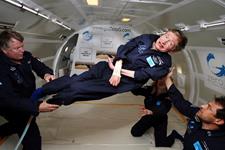
Above: Stephen Hawking in a screenshot taken during a zero-gravity training session in 2007 at the 'Shuttle Landing Facility', NASA – 'J.F. Kennedy Space Center' Airport (Florida).
"I have had motor neurone disease for practically all my adult life. Yet it has not prevented me from having a very attractive family, and being successful in my work. This is thanks to the help I have received from my wife, my children, and a large number of other people and organizations. I don’t regard myself as cut off from normal life... I don't feel disabled, but I think I am just affected by certain malfunctions of my motor neurones, a bit like being color-blind. I think it is difficult to describe my life as normal, but I feel normal..."[2]
The publication in 1988 of his ‘A Brief History of Time: From the Big Bang to Black Holes’ remained at the top of the bestseller list for 237 weeks, as also reported by the London 'Sunday Times': this especially surprised Stephen Hawking, and not only because the subject of the book was his own scientific passion.
"Space-time was a topic that intrigued me, I thought it was a 'Fantasy' genre[3] and so I opened that chapter immediately: but as I began to read, I realized that Hawking – contrary to some comments describing him as a rigorous, academic type – asked instead to observe real phenomena which I knew too, using initial skills quite close to mine... He also suggested some flexibility in thinking about space-time, for example as a fabric to work on... I think I can recommend reading it to just about everyone, for his ability to clearly explain complex scientific information in both historical and contemporary contexts, using interesting examples and point by point, that is, schematically..."[4]
"Imagination is a work – Hawking observes – that confronts observation, for example, of the 'regularity' of an event... By observing lunar eclipses, Aristotle understood the interposition of the sun and the moon..."[5] Writing allowed for the recording of data that would otherwise have been forgotten: the first scientists began to write in order to record the movement of lights in the sky. Furthermore, by putting forward hypotheses, for example on the existence of an attractive force between planets, the work of some scientists presented itself as a reliable legacy to lean on: Hawking thus discovers that his spontaneous narcissism would instead be an obstacle to the scientific success he was already beginning to experience.
"This voice synthesizer [6] is by far the best I have heard, because it allows for variation in intonation and does not speak like a robot. The only unpleasant thing is that it gives me an American accent. Now, however, I have identified with this voice, and I would not want to change it even if I were offered a voice with a British accent. I would feel like another person... My youngest son, who was only six years old when I underwent a tracheostomy, could never understand me. Now he has no difficulty. This is a very important thing for me... In my work, I find it a great help to describe my ideas to others. Even if they don't give me suggestions, the simple fact of having to organize my thinking so that I can explain them to others often leads me to new steps forward... Physics is beautiful, but it is completely cold; I could not bear my life if I only had physics..."[7]
"...Simple in his manner, I think that for this reason too Hawking managed to surprise those who expected him to be a difficult scientist...", adds Michela Membretti.
"I just want to have the same degree of control over my life that other people have over theirs... Too often it happens that disabled people have to let their lives be governed by others. No able-bodied person would allow that."[8]
"From an initially religious attitude of primitive humans who did not dare look at the sky, Hawking points out a gradual confidence of the first scientists: they realized that the sun rose every day regardless of rituals or sacrifices, and this increased confidence in their own work of study and observation...", comments Michela Membretti.
"Hawking writes in a simple, clear, balanced way: yet his sympathy is evident for Galileo Galilei who, despite the scientific results he was certain of, obeyed the Church which asked him to stop his experiments. But above all, Hawking expresses sympathy for Albert Einstein, of whom he considers himself somewhat an heir because in 1935 Einstein advanced, together with Nathan Rosen, the hypothesis of space-time tunnels, a precursor to the discovery of 'black holes' and the subsequent 'Stephen Hawking radiation'".
"Today we know that general relativity and quantum mechanics are in contradiction with each other..."[9]
"Anyone who reads science fiction novels knows what happens to someone who ends up in a black hole: they are turned into spaghetti. But the most interesting thing is that black holes are not completely black. They emit particles and radiation at a constant rate. As a consequence of this emission, a black hole slowly evaporates, but it is not yet known what finally happens to it and to what it contains..."[10]
"Past history cannot be changed and alternative histories are not possible... The laws of physics prevent macroscopic bodies from carrying information into the past... The study of gravity and the early universe are the best path toward the possibility of a unified theory..."[11]
"All that my work has shown is that one should not say that the way the universe began was a personal whim of God..."[12]
Pedagogy, in short, which attempts to explain what would not be evident, was of no use to God.
Marina Bilotta Membretti/ Cernusco sul Naviglio - July 11, 2019
TutorSalus.net – Freudian journalism
[1] Stephen Hawking (1942-2018) was a British cosmologist, physicist, mathematician, astrophysicist, and academic among the most authoritative and well-known, famous for his studies on black holes and the origin of the universe. His main contributions were 'Hawking radiation', the cosmological theory called the 'Hartle-Hawking state', 'the multiverse', 'cosmic inflation', and 'galactic formation and evolution'.
[2] Stephen Hawking, "Black Holes and Baby Universes", 1993 - Ed. Rizzoli BUR, taken from the Interview December 25, 1992 / BBC for the program 'Desert Island Discs'.
[3] 'Fantasy' is a broad genre in Literature with varied plots between reality and imagination; it also includes authors now considered classics, such as J.R.R. Tolkien of 'The Lord of the Rings'.
[4] Michela Membretti holds a degree in Pharmacy and works in a company: this article was born from her suggestion to read Hawking.
[5] Taken from ‘A Briefer History of Time’, Stephen Hawking with Leonard Mlodinow – Ed. Rizzoli 2005.
[6] 'Speech synthesis' is a technique for the artificial reproduction of the human voice: a speech synthesizer can be implemented via software or hardware.
[7] Taken from the Interview December 25, 1992 / BBC, 'Desert Island Discs' program, cited.
[8] Taken from the Interview December 25, 1992 / BBC, 'Desert Island Discs' program, cited.
[9] Taken from "A Briefer History of Time", Stephen Hawking with Leonard Mlodinow – Ed. Rizzoli 2005.
[10] Taken from the Interview December 25, 1992 / BBC, 'Desert Island Discs' program, cited.
[11] Taken from "A Briefer History of Time", Stephen Hawking with Leonard Mlodinow – Ed. Rizzoli 2005.
[12] Taken from the Interview December 25, 1992 / BBC, 'Desert Island Discs' program, cited.