

The art of lace[1].
A work by… I! Our thinking no longer tangled.
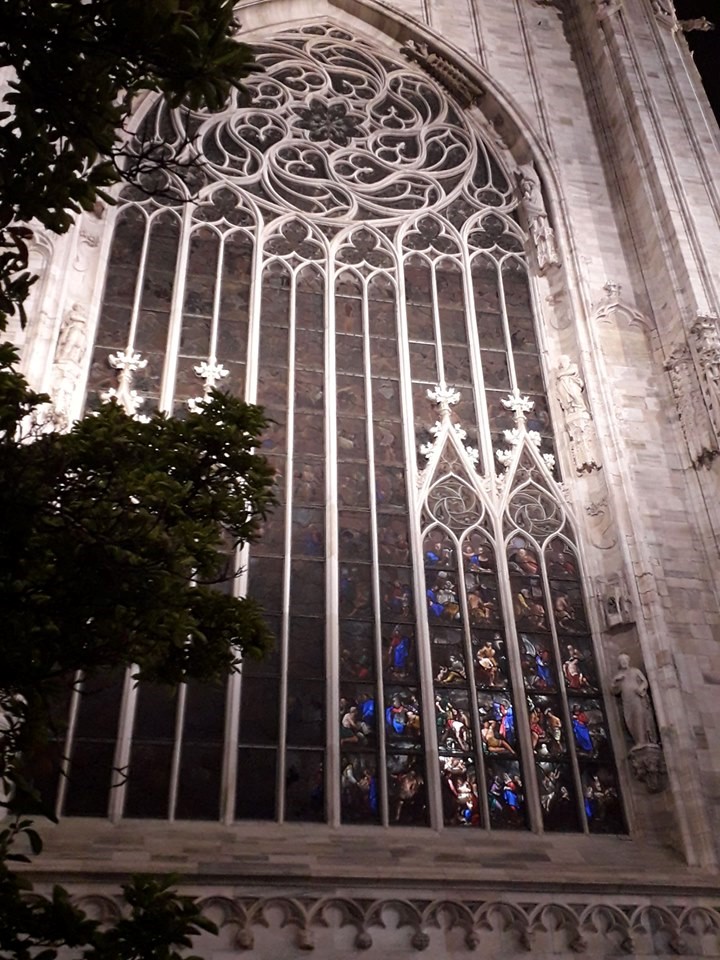
Almost like a precious embroidery can appear the marble decoration from the outside of the Duomo’s apse in Milan, dedicated to ‘Mariae nascenti’.
What makes an embroidery immediately appreciable, and instead unpleasant a tangle of knots ? It is on this that the success of an artefact with very high added value is based, already in use towards the end of the Middle Ages in Italy.
The tools are very simple, the bobbins, the needle and the cylindrical bobbin, but solid technical expertise is required, that cannot be passed down either in words or in books, because it must rely on a good and adequately designed drawing, ‘the trace’.
Courted by noble and later bourgeois patrons, even the workshops Masters of the early Renaissance went so far as to hand over a ‘designer’ sketch, which however then required a special mastery in interpreting the shadows, essential to understand the drawing, until obtaining that thin, precious and resistant artefact of considerable value : so much so that its most sought after use was, and is still now, for haute couture. But lace for sumptuous tapestry and furnishing accessories can even be found in notarial records of spousal contracts, deposited in medieval archives.
The invention of needle-worked lace, which so frequently characterizes 18th century Venetian fashion, perhaps dates back to very ancient times and to distant civilizations that commercial activities brought together : for our Latin ancestors, in fact, needle stitching only concerned ‘mending’ which however rarely comes close to that skilful interweaving of fine threads that makes embroidery.
Suddenly, as a matter of fact in the Middle Ages the display of laces and embroideries makes the appearance, for example in the cities, in the astonishment and in the rivalry of the different Guilds, continuing then in more recent times – as happened in 1888 and then in 1959 for example at Cantù, headquarter of one of the most Italian renowned embroidery’s schools - with the opening of professional and even public schools. The rapid transition of 50s and 60s fashion to modern prêt-à-porter cause a rarefaction of professionalism which leads to an incredible increase in the value and cost of the commissioned product, with the consequent reduction in the number of precious artefacts available to buyers.
Maintaining the ability to create unique ‘pieces’ – even and still designed by contemporary artists[2] - the art of lace remains an invitation to use one’s own thinking, and even more so when it gets tangled restlessly, to unravel the threads and rebuild an order that is very similar to the oneiric and to those night dreams, apparently indecipherable and twisted but real indeed, of which we must admit that we ourselves are the authors.
Marina Bilotta Membretti / Cernusco sul Naviglio – November 13, 2019
TutorSalus.net - Freudian journalism
[1] Thanks to ‘Palazzo Morando’, home of the ‘Museo di Milano’ and of the collection ‘Costume Moda Immagine’ which recently hosted the exhibition ‘Merletti e Design : intrecci creativi a Cantù dal Novecento ad oggi’. Thanks also to the Association ‘Italia Medievale’ for the presentation of ‘L’arte del sarto nel Medioevo. Quando la moda diventa un mestiere’ (2018, Ed. ‘Il Mulino’) by Elisa Tosi Brandi, young researcher in ‘Medieval History’ at the Università degli Studi of Bologna, who specifically studied the history of fashion craftsmanship.
[2] ‘Lombardini22’ is the professional Studio in Milan which designed ‘Cathedral’, a lace that takes inspiration from the ‘endless knot’ by Leonardo Da Vinci, on the occasion of the five hundredth anniversary which is celebrated in Milan, and using techniques applied to digital. NeSpoon is the stage name of a Polish artist who is making herself famous for her ‘street art’ of antique lace with which she decorates city buildings.