

Sovereignism at fault.
‘Edipo a Colono’[1] directed by Robert Carsen[2] for the Greek Theatre of Siracusa.
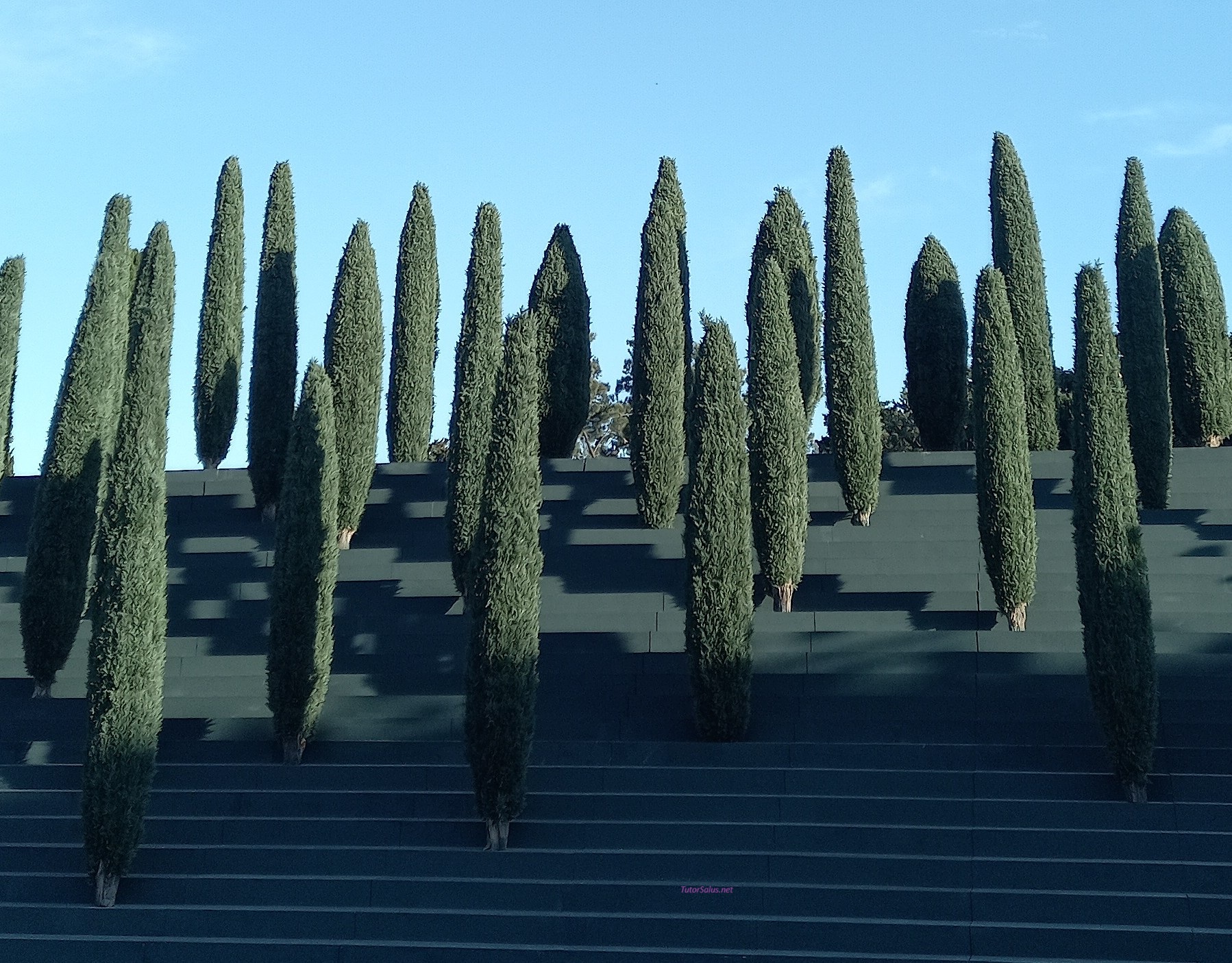
In the photo: the opening that the director Robert Carsen wanted for this 2025 edition of ‘Edipo a Colono’ (Sophocles, 401 b.C.) at the ‘Greek Theatre’ of Siracusa: the grove sacred to the gods, where Oedipus is seeking and obtains eternal sleep, is an army of posts just masked by dark fronds, which even the rustling dress of the Eumenides doesn’t make one tremble.
Faithful to the text by Sophocles, the ancient Oedipus emphatically makes his way onto the scene: he, as a sovereign self authorized not to recognize the sovereignty of others, has already punished himself by blinding for his sins, and no one else will be able to do more, nor the glimmer of forgiveness vibrate in his chest.
It is certain that Oedipus does not seek forgiveness: he, who did not know, obeyed Fate, and this assures him the candor of innocence and the right to the just, pacifying sleep that he has come to Colonus to collect.
Not a formal speech that wouldn't hold up, the fallen king Oedipus stubbornly beats the old fanfare stick that strikes, distracts, and raises. “The crime was partly legitimate... Because I killed, I murdered without knowing. I am innocent before the law: I arrived at that point unaware.” [3]
Sophocles does not attempt to hide the stolidity of this claim, and rather offers the already blind Oedipus to a confrontation to which he remains deaf too. “Poor Oedipus! Not even with age will you acquire reason? You are an insult to old age...” [4] And the immobility of the sacred grove would be perfect for this fallen king if the wound of a call did not come to crack it.
Polynices, Oedipus's eldest son, asks Theseus, the king of Colonus and hospitable to Oedipus, to have "...a brief, non-binding, interview"[5] with his father. “He asks, it seems, to be able to meet with you and then return safely by the same way he came.” [6]
But Oedipus here, though favoured by the gods, now creaks terribly as a human and as a king. “He is my son, king, a son I detest. Listening to him would cost me the keenest pain... His voice, king, is hateful to my ears. Do not force me to yield on this point.” [7]
“...He is your son!”, even the daughter Antigone urges Oedipus. “Even if he had done the most ignoble wrongs to you, you would not have the right, father, to repay evil with evil... Do not look at the present: instead, think back to the wounds that your father and mother inflicted on you; then without a doubt you will understand that blind anger can only produce trouble... Yes, I know: who makes a just request should not insist, but also who has received good should know how to return it.” [8] And indeed the entrance of the eldest Polynices is explicit.
“I recognize that I have behaved like the most infamous of men, regarding your sustenance, father. There is no need for someone else to tell you. But since for every event, Piety sits on the throne next to Zeus, well, let her come to your side, my father. It is still possible to remedy the mistakes made, but one can no longer descend lower. Why are you silent? Say something, my father. Don't send me away. So you don't want to answer me and you will send me away without deigning to say a word, without even explaining the reason for your resentment?” [9] “I ask for forgiveness... because I cannot help it.” [10]
Then the virtuous protagonist that Oedipus begged for himself is instead dragged into judgement, and without being able to claim the royal trappings from which he is immediately stripped.
“You, miserable, you who had the scepter and the throne that your brother now possesses, in Thebes, you drove your father out...: I have only to endure this squalor until the end of my life, without ever forgetting that you are my murderer... Go then, with all my hatred: in me you will no longer have a father, infamous among the infamous... So I curse you.” [11]
Antigone, his daughter, then right says: “My father wanted to die in a benevolent land, and dies alone.”[12]
Marina Bilotta Membretti / Cernusco sul Naviglio – August 16, 2025
TutorSalus.net - Freudian journalism
Please note: from August 20th to 31st www.tutorsalus.net will not be accessible to the public for a technical update: the publication of the articles will resume in September 2025.
[1] ‘Edipo a Colono’, Sophocles (Colonus, 496 b.C. – Athens, 406 b.C. The work was presented to the public posthumously in 401 b.C.). Edition 2025 for the ‘Greek Theatre’ of Siracusa www.indafondazione.org / Direction by Robert Carsen. Translation: Francesco Morosi. Scenes: Radu Boruzescu. Costumes: Luis Carvalho. Music: Cosmin Nicolae. Main performers: Giuseppe Sartori, Fotinì Peluso, Massimo Nicolini, Paolo Mazzarelli, Simone Severini. Choir leaders: Rosario Tedesco, Elena Polic Greco. With the participation of the students of the ‘Accademia d’Arte del Dramma Antico’ of Siracusa.
[2] Robert Carsen was born in Toronto (Canada) in 1954 and since he was a child he demonstrated a great passion for theatre: so he began studying acting, but at 20 years old he moved to England to continue his studies in directing, getting his first job as an assistant director at the Festival of Spoleto (Italy) and in the same time at the Royal Opera House of London, which allows him to collaborate for a long time with the prestigious Glyndebourne Festival Opera; already engaged as an assistant director for the Canadian Opera Company, he stands out as a set designer in 1987 with the National Ballet Canada at the Grand Théâtre de Genève; among his best works we remember: ‘The Nibelung’s Ring’ at Cologne, ‘Eugene Onegin’ at the Metropolitan Opera, ‘La Traviata’ at the Theatre ‘La Fenice’ of Venice, ‘Mephistopheles’ at the San Francisco Opera, ‘Rusalka’ at the Opéra Bastille of Paris, ‘The Knight of the Rose’ at Salzburg Festival; in Germany he directed many works by G. Puccini and G. Verdi until he began a collaboration with the Teatro alla Scala of Milan which still continues; in 2001 he directed the musical ‘Sunset Boulevard’; at the Greek Theatre of Siracusa (Italy) he directed ‘Oedipus Rex’ and ‘Oedipus at Colonus’ by Sophocles; he received many awards and was honoured with the Order of the Legion of Honour (France, 1996) and with the Order of Canada (2006).
[3] ‘Edipo a Colono’, Translation and Notes by Franco Ferrari – Biblioteca Universale Rizzoli (2000), p.317.
[4] Ibid, p. 335 : Creon, the ruler of Thebes and Antigone’s stepfather, faces the fugitive Oedipus to bring him back to Thebes.
[5] Ibid, p. 361.
[6] Ibid, p.361.
[7] Ibid, p.361.
[8] Ibid, p. 363.
[9] Ibid, p. 369.
[10] Polynices cited from the text presented by the director Robert Carsen.
[11] ‘Edipo a Colono’, Translation and Notes by Franco Ferrari – Biblioteca Universale Rizzoli (2000), p. 375.
[12] Antigone cited from the text presented by the director Robert Carsen.