

Strange.
The painter Giovanni Fattori and his own 'macchia'.
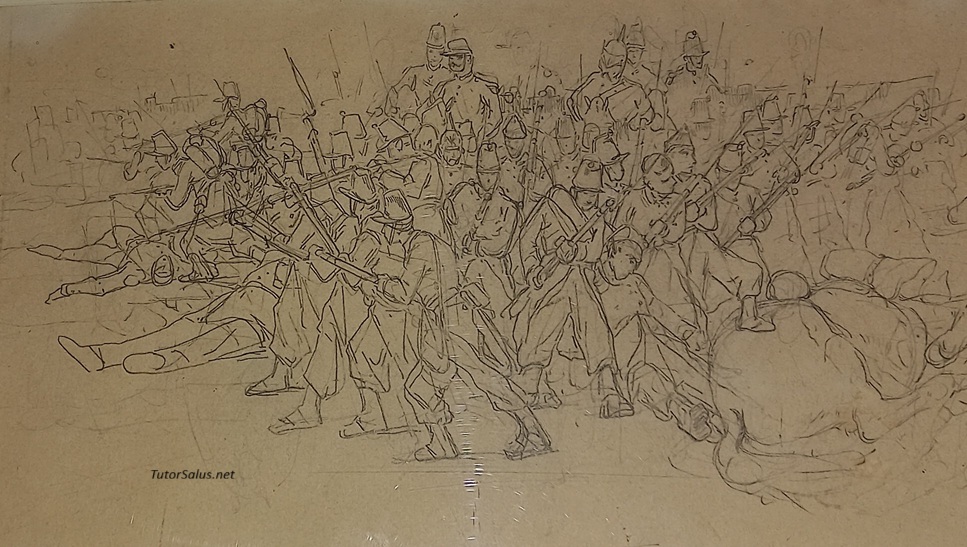
In the photo: detail of a preparatory drawing for the four large paintings of the Risorgimento battles, which Giovanni Fattori submitted to the competition announced for the provisional government of Tuscany, and which the artist won in 1862 with ‘Il campo italiano dopo la battaglia di Magenta'/ Taken from the exhibition ’Giovanni Fattori. Il ‘genio’ dei Macchiaioli’, Piacenza/ Museo XNL March 29 – June 29, 2025.
A special graphic ability is in Giovanni Fattori[1]: and painting to which he later applied himself cannot dilute it, or reduce. Called to live in a time when people were fighting for an “unborn Nation”[2], he soon became close to the nascent ‘Macchiaioli’[3] who met at the ‘Caffè Michelangiolo’ in Florence, quickly making himself one of the most unique and successful interpreters.
The ‘macchia’ began to take shape for the artist with the arrival in 1859 in Florence of the French troops and their camp, which Fattori, at that time newlywed of Settimia Vannucci, would stop for whole days to observe from the ‘Pratone delle Cascine’, and the real battles that were being prepared, the waiting, the death, the suffering: his special scratching on the paper found meaning and passion right here to depict the brutal scenes of the completely real movie that was in front of him: and to depict his own thinking too that on their pain could bend and say and describe, with the sharp lines of which he was a master.
Giovanni Fattori was also a master of colour which his paintings still offer to us, easing and making suffering and loneliness acceptable, as he witnessed even with contrition, a refined pain to which he knew how to address his rare ability to make it sublime, elect.
His own ‘macchia’ – unique among his colleagues ‘Macchiaioli’ – is indifferently man, woman, animal, without expressions, up to ‘the people’ which finds with Giovanni Fattori a true significance because the ‘who the other is’ gives up. Women, including his wife and a common friend, make landscape in ‘La Rotonda dei bagni Palmieri’ (1866) : as well as ‘I bovi al carro’ (1868) are protagonists full of light. A ‘gayeté’ in the ‘tristesse’ that made him fascinating to the public, and consumable: Fattori had many loves.
His most, maybe incomprehensible and secret works are the portraits, some of which followed him during his moves; excellent caricatures and ‘macchia’ of the human: not very resembling but truly romantic and realistic in the subtle affection they are able to arouse.
It's strange however that only in his self-portraits Fattori does not make himself ‘macchia’.
Marina Bilotta Membretti/ Cernusco sul Naviglio – November 6, 2025
TutorSalus.net - Freudian journalism
[1] Giovanni Fattori (Livorno 1825 – Firenze 1908) was an Italian painter and engraver: lively and lazy student at the ‘Accademia di Belle Arti’ in Florence, as he himself admitted he approached the painting technique of the ‘macchia’ but he didn’t appreciated Impressionism. He won many awards between 1870 and 1890, and his ‘Il Quadrato di Villafranca’, appreciated by the king Umberto I, was purchased by the ‘Galleria Nazionale d’Arte Moderna’ of Rome. In 1880 he was appointed Honorary Professor at the ‘Accademia di Belle Arti’ of Florence, and he was invited to participate in prestigious exhibitions throughout Europe. His paintings are present at the Civic Museum ‘Giovanni Fattori’ in Livorno, at the ‘Galleria d’Arte Moderna’ of Palazzo Pitti in Florence, and at the ‘Galleria nazionale d’Arte Moderna’ in Rome.
[2] Taken from the presentation of the exhibition in Piacenza ‘Giovanni Fattori. Il ‘genio’ dei Macchiaioli’, XNL Museum/ March 29 – June 29, 2025.
[3] Macchiaioli were in Florence a group of painters, critical of the Accademia teachings: first and foremost Diego Martelli ed Adriano Cecioni, who already in 1855 – well before the French Impressionists – had developed a theory and a technique where light creates ‘patches’ of colour. It was on the occasion of their first exhibition of 1862, that ‘la Gazzetta del Popolo’ named them for the first time and in a slightly irreverent way ‘Macchiaioli’, although some of them were actually soldiers in those dark years. Among the best interpreters still remain Odoardo Borrani, Silvestro Lega, Telemaco Signorini.