

…Really?
Antigone and Democracy.
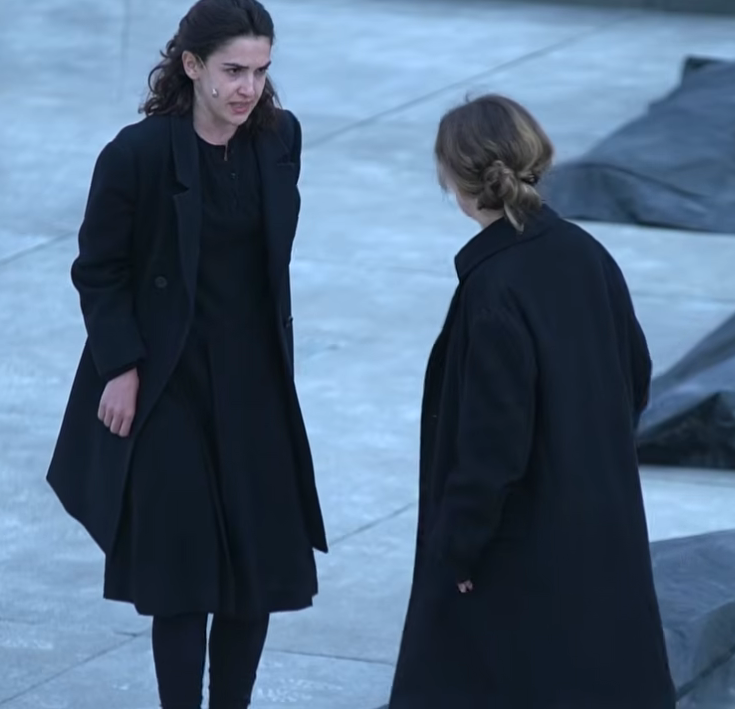
In the photo: Ismene addresses her sister Antigone at the beginning of the drama: "Where is your thinking heading?" / screenshot shared from https://www.youtube.com/watch?v=QkrbTNAtC7Q // 'Antigone' by Sophocles[1], directed by Robert Carsen[2] for the 2026 Season at the Greek Theatre of Syracuse / I.N.D.A. Foundation.
‘Antigone’ was Sophocles' first play, achieving an immediate success that still transcends opposing political views today; the vast consensus this tragic character has always gathered[3] is truly incredible. Yet, Antigone maintains the stance of the ‘old world’ - Antigone is the girl who "opposes the generating" - a low human matter that does not concern the gods and their immutable laws. Indeed, we already found her clinging to her affection for a past no longer connected to reality.
"A desire overcomes me... to see the underground home... of our father, alas"[4], Antigone confesses her "desire" to her sister Ismene after their father, Oedipus, following his own will and the favour of the gods, had vanished from this world near Colonus, without leaving ant trace. Antigone had arrived there as an exile from Thebes, supporting her blind father. For a long time, he had proclaimed himself "not responsible" for the crimes he had nevertheless committed, justifying the offense with his "not knowing" what he was doing and against whom; the gods had destined him to all this, and he had obeyed them. Antigone makes herself an affectionate and loyal, yet senseless, ornament to his father Oedipus.
"Where is your thinking heading?" [5] Ismene asks her sister from the very first lines of the drama. Antigone has suggested to Ismene to join her in disobeying the recent law of the sovereign Creon. This law decrees that no one—under penalty of death—shall honour in any way the body of Polyneices. He was the son of Oedipus and brother to Antigone and Ismene, killed in battle by his own brother Eteocles while attempting to seize the throne of Thebes—the throne from which Oedipus had been banished and which is now occupied by Creon, brother of their mother Jocasta. Ismene, "she who knows, she who has a mind," questions Antigone's thoinking.
Antigone, who is escaping reality, is fallen in love with whom no longer are in the world: not even the Chorus can do better than Ismene, and we listen them mourning Antigone until the very end.
It is in fact the contrast by Ismene—who prefers to obey Creon, the representative of Government and Law—that amplifies the aim of Antigone's naive heroism, with a tragic emphasis on the—yet possible—detachment between an obscure affection, an infatuation that becomes superhuman, and the law, which recognizes reality as the source of life that the gods despise.
This contrast is the true protagonist that takes the stage, yet it remains unknowable, subdued, even sly, managed by Sophocles to enchant the audience. "It is my nature to share love, not hate"[6], Antigone proclaims to the tyrant Creon: a love frozen in the infatuation that precedes tragedies. And here, Sophocles' words uses the counterposition of two verbs that in ancient Greek indicated neither love nor hate, but an unrelated and fluid feeling capable of sweeping the listener away.
The detestable, hateable Creon clearly understands Antigone's affection, but at the same time expresses the impossibility of pleasing her wish, at risk of the Government's credibility and its very existence: "Whomever the city has entrusted with power, they must one obey in matters large and small, just or unjust... There is no evil greater than anarchy, which ruins cities, disrupts families, breaks ranks, and causes flight in the midst of battle." [7]
It is certainly a despotic society in which Ismene and Antigone move but, what if it were a democracy?
Behold, democracy itself makes ‘Antigone’ a significant test of the consensus for rebellion: a consensus that is even social, given that ‘Antigone’ has availed herself of it over the centuries, and from opposing factions. Antigone pleases the gods, and the gods despise reality.
Yet even today, the impassive, unsettling Sophocles asks us, and precisely through Ismene, the sister who knows and yet remains on the sidelines: why discard reality—and therefore the 'real'—which indeed derives from reality the principle of generating, the principle of pleasure ?
Otherwise, there is nothing but Imago.
Marina Bilotta Membretti/ Cernusco sul Naviglio – June 28th, 2026
TutorSalus.net - Freudian journalism
[1] Sophocles (Colonus 496 b.C. – Athens 406 b.C.) was one of the three most highly applauded authors of ancient Greece, along with Aeschylus and Euripides. In Tragedy, he introduced the third actor and increased the composition of the Chorus, which became more spectacular. His protagonist is a well-rounded dramatic one, with a more pronounced humanity. He brought to the Theater as his first work ‘Antigone’ (442 b.C.), then we note ‘Oedipus the King’ (425 b.C.), ‘Electra’ (410 b.C.), and ‘Oedipus at Colonus’ (401 b.C., performed after Sophocles death). He was a friend of Pericles and politically engaged, and received important political positions.
[2] Robert Carsen was born in Toronto (Canada) in 1954 and since he was a child he demonstrated a great passion for theatre: so he began studying acting, but at 20 years old he moved to England to continue his studies in directing, getting his first job as an assistant director at the Festival of Spoleto (Italy) and in the same time at the Royal Opera House of London, which allowed him to collaborate for a long time with the prestigious Glyndebourne Festival Opera; already engaged as an assistant director for the Canadian Opera Company, he stood out as a set designer in 1987 with the National Ballet Canada at the Grand Théâtre de Genève; among his best works we remember: ‘The Nibelung’s Ring’ at Cologne, ‘Eugene Onegin’ at the Metropolitan Opera, ‘La Traviata’ at the Theatre ‘La Fenice’ of Venice, ‘Mephistopheles’ at the San Francisco Opera, ‘Rusalka’ at the Opéra Bastille of Paris, ‘The Knight of the Rose’ at Salzburg Festival; in Germany he directed many works by G. Puccini and G. Verdi until he began a collaboration with the Teatro alla Scala of Milan which still continues; in 2001 he directed the musical ‘Sunset Boulevard’; at the Greek Theatre of Siracusa (Italy) he directed ‘Oedipus Rex’ (2022) and ‘Oedipus at Colonus’ (2025) by Sophocles; he received many awards and was honoured with the Order of the Legion of Honour (France, 1996) and with the Order of Canada (2006).
[3] ‘Jacques Lacan - Il seminario. Libro VII. L’etica della psicoanalisi. 1959 1960’, Piccola Biblioteca Einaudi (2008) A cura di Jacques Alain Miller, Antonio Di Ciaccia.
[4] Cited from ‘Edipo a Colono’, Sofocle (401 a.C.) BUR Fabbri Editori in ‘Antigone, Edipo Re, Edipo a Colono’ (2000) Translat. by Franco Ferrari - pp. 399-401.
[5] Cited from ‘Antigone’, Sofocle (442 a.C.) BUR Fabbri Editori in ‘Antigone, Edipo Re, Edipo a Colono’ (2000) Translat. by Franco Ferrari - p. 63.
[6] Cited from ‘Antigone’, Sofocle (442 a.C.) BUR Fabbri Editori in ‘Antigone, Edipo Re, Edipo a Colono’ (2000) Translated by Franco Ferrari - p.97.
[7] Cited from ‘Antigone’, Sofocle (442 a.C.) BUR Fabbri Editori in ‘Antigone, Edipo Re, Edipo a Colono’ (2000) Translated by Franco Ferrari – pp. 107-109.