

The public debate, including culture, theatre and cinema through the economic perspective of the Freudian journalism.
Events
You’ve been and still exist.[1]
Leonardo Da Vinci and the objection of Conscience.
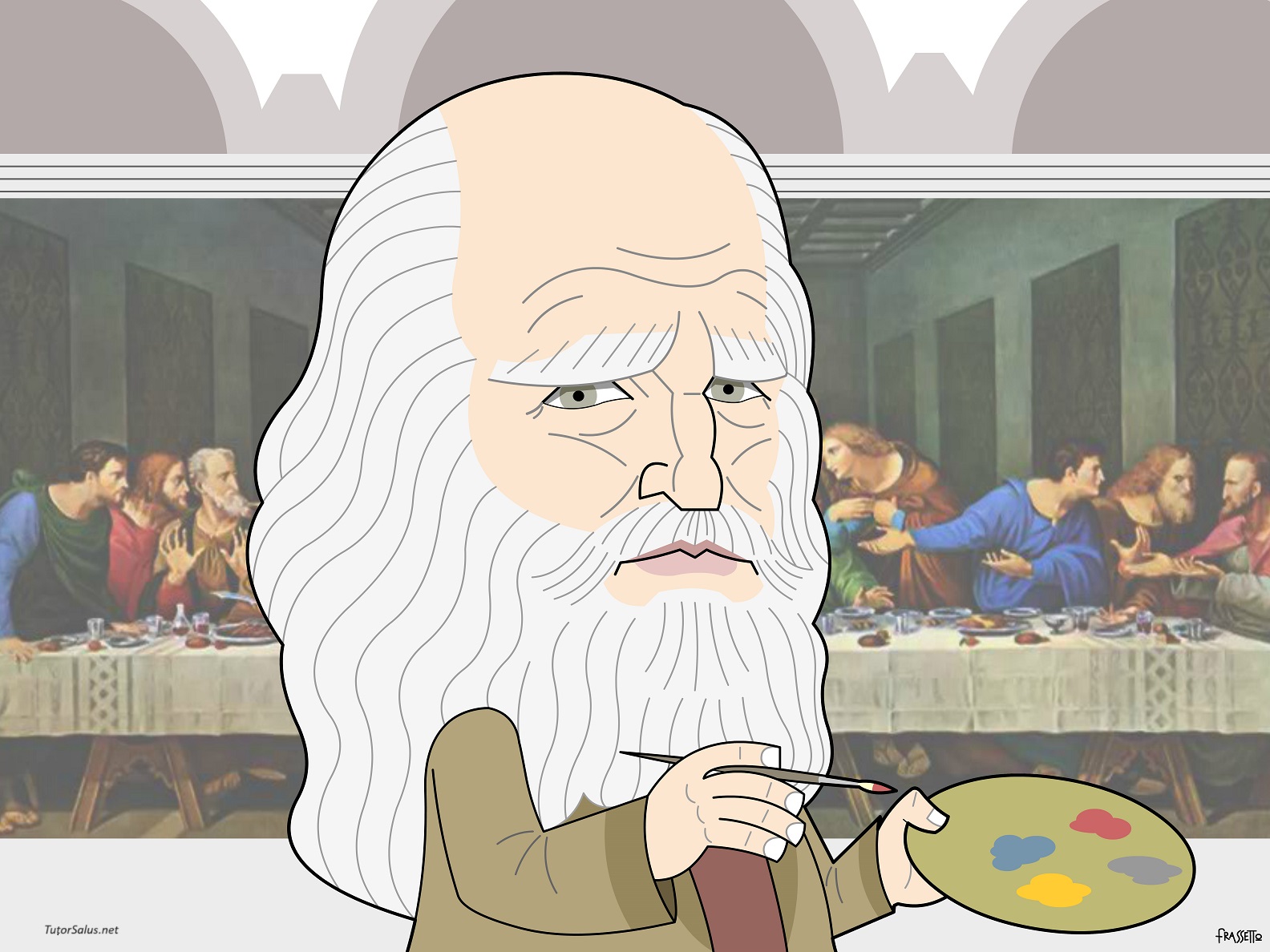
Original painting by Stefano Frassetto (6).
Leonardo Da Vinci was painting the ‘Cenacolo’[2] in Milan, between 1494 and 1497, on commission of Ludovico il Moro, to the Court of whom he specifically came from Florence. Leonardo didn’t like painting religious themes and preferred, to the culture of the clergymen, the cruel and lashing one of his patron, who however did right ask Leonardo with the ‘Last Supper’ for the refectory of the convent of Santa Maria delle Grazie. So that Leonardo should ‘come into’ the person of a thinking Jesus. He chose the sorrowful acknowledgement without any condemnation : “One among you will betray me… The one who’s dipping into my own plate.” [3]
Leonardo did work enigmaticly : the apprentice Matteo Bandello reported about him that sometimes the Master was been working non-stop even for lunch, and sometimes instead he gave just a few brushstrokes and left, disappearing until the next day. Especially about the ‘Cenacolo’, Leonardo often covered again what he himself had already painted. Thanks to a restoration lasted twenty years and able to come back to the original painting, nowadays we can know how was thinking a man said a genius, but mainly treated by his own contemporaries as an odd kind of person and not to be approached.
Sigmund Freud published in 1910 ‘A childhood memory of Leonardo Da Vinci’, twelve years after his shortest but dedicated stay in Milan, in September 1898 and after publishing ‘The translation of dreams’ and the well done ‘Case of child Hans’. Also the essay about Leonardo Da Vinci was once more dedicated to know how a child is thinking to be conjugated, and the corruption of his thinking in the said ‘Oedipus complex’, as an inhibition and objection of Conscience to love.
During his visit in Milan, Freud didn’t find that fresco in the persuasive condition as we today can enjoy it, so that he couldn’t free Leonardo from inauspicious diagnosis which Freud himself only supposed, that is a ‘natural’ and biological perversion, a capacity at the limit of the human, inhibiting up to directly sublimate the desire for conjugation so staying on this side, almost an insuperable fence built by one’s own thinking and from where oneself thinking does jump somewhere else, without any reasonable link. Any technical and scientific skill would then have substituted in Leonardo child and then young man, replacing as a whole any trace of love, passion or libido, raising the man to a genius, damned by the nature itself.
However, we know today it was not, thanks to his own thinking offered by Leonardo in his ‘virgin’ work, before his following uninterrupted changes of mind, undoubtedly proved by the different coats of painting and by the overlapped brushstrokes.
First of all, Leonardo preferred, but without any evident reason, the ‘dry fresco’ technique which, opposite to the traditional ‘fresco’ technique which he himself well knew, would have exposed his work in progress, and during that longest making up, to a rapid and irreversible decay. Almost if he would hide, in the foreseeable ruin of that fresco, his true thinking which was a thinking love.
Working hard to be able to come into Jesus thinking, Leonardo got to think indeed the conjugation he desired but finding himself betrayed hurted violated.
In ‘Cenacolo’ there is a game of hands, something prepared to escape an audience looking at the faces, and showing what the painter really was thinking about the relation between Jesus, so bright and central, and Judas, twisted and shadowed figure.
Since that dream Leonardo reported and commented by Freud, the bird of prey represented an aggressive and choking maternal affection. In ‘Cenacolo’ of Milan the greedy hand diverted by possession comes back with evidency, and will not link again the loving hand of Jesus-Leonardo, also if turning towards Judas’ hand, in whom Leonardo represented his own father, Ser Piero Da Vinci.[4]
Lacking legitimate offspring infact, ser Piero Da Vinci bought Leonardo from his own natural wife, almost collecting the child as he lacked of legitimate children, but ignoring that Leonardo would like to be loved by his father.
When the fresco was ready, the lavish Ludovico il Moro had no more money to pay the excellent work made by Leonardo, who had to accept - swallowing yet another disappointment - a famous vineyard in the centre of Milan. After that ‘Cenacolo’ Leonardo didn’t come back on the item, also if that important work opened to him his hidden capacity to love, even subsequently an unsatisfying maternal rapacity.
His own thinking of love was no more over, nor he was biologically not able to love as Freud, wondering assumed.
Leonardo however didn’t arrive on time to enjoy a real analytical work, so proving[5] his own buds of ‘salus’ he could cultivate.
Marina Bilotta Membretti / Cernusco sul Naviglio - May 24, 2016
TutorSalus.net - Freudian journalism
[1] This text has been briefly proposed during a Work session in class in the past ‘Symposium 2015 – 2016’.
[2] I took part in the guided tour of the Association “Neiade Immaginare arte”.
[3] Mathew Gospel - Mt 26, 20-25
[4] Ser Piero Da Vinci, was living between 1427 and 1504 and was father of Leonardo, also notary in Florence and man of culture.
[5] Il pensiero di natura, Giacomo B.Contri – SIC Edizioni (1998). It’s clear the thesis that any individual thinking works ‘on’ the biological nature and not recognizing oneself as submissive : that is since the birth of a child.
(6) Stefano Frassetto is born in Turin in 1968. After his degree in Architecture at ‘Politecnico’ he begun as graphic novelist for local magazines. In the ‘90s he edited in France too, on ‘Le Réverbère’ and on ‘Libération’ : then he created ‘Ippo’ for ‘Il Giornalino’ and then the stripe ‘35MQ’ for the swiss magazine ‘20 Minuti’. In 2000 he came into ‘La Stampa’ as portraitist for cultural page and the insert ‘Tuttolibri’, then for the weekly ‘Origami’. Today he works also for the swiss magazine ‘Le Temps’.
Federico da Montefeltro[1].
A winner’s day: the painting by Piero Della Francesca.
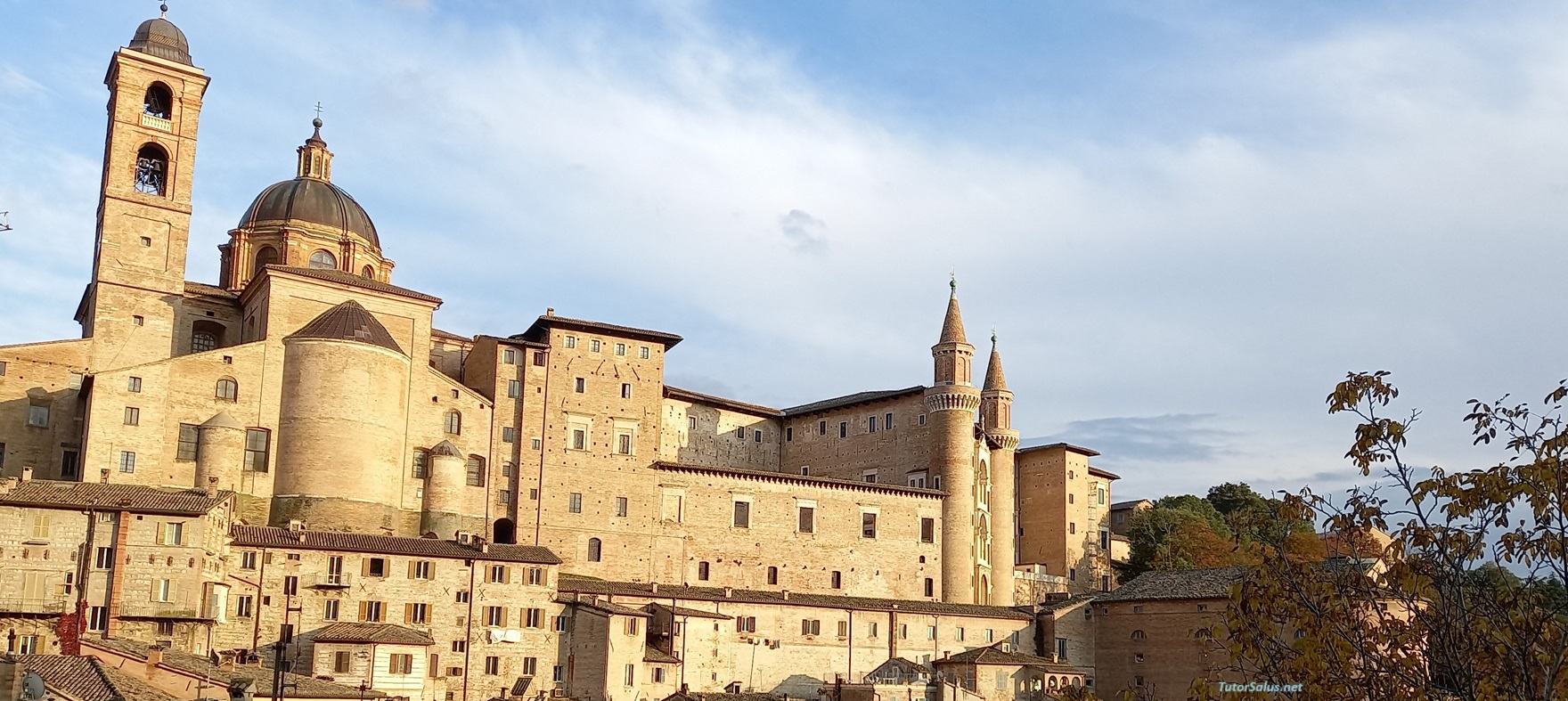
In the picture : morning view of the Palazzo Ducale in Urbino, residence and seat of government (1444 to 1482) of 'Federico II da Montefeltro'.
‘A winner’s day’ is the title I would attribute to the work by Piero della Francesca[2] which I was admiring a few days ago at the ‘Pinacoteca di Brera’ in Milan. Many titles actually alternated : ‘Sacred conversation’[3], or ‘Madonna of the egg’, or ‘Madonna with Child and Saints’ and finally now ‘Pala di Brera’, thus proposing a completely new order.
I stood for a long time in front of Federico da Montefeltro, an ugly and probably rude but touching man in the armour in which he tries to defend himself or simply not to reveal himself - despite being a very capable warrior, accustomed since his childhood to the mistreatment that a child suffers because he was born outside of a noble marriage.
However obedient without resignation, Federico kept the memory of that few of love he even received, as well as of the disadvantages and mistreatments that undoubtedly hurt him. But the education in a monastery – education moreover decided by the family out of mistrust and calculation - allowed him not to give up his own thinking, which in fact he actively cultivated and in many directions, including his sincere dedication to Battista Sforza, his second and re-beloved wife.
Looking at him carefully his profile moved me, because disfigured by a primitive plastic surgery on the nose which however allowed him to use his eyesight, seriously compromised by that accident between riders : I was moved by his bent knees, made more noticeable by knee pads, placed at his side with a scruple of reality. But above all I liked his non-greedy look on the sleeping Child, that also meets a goal to which his own bride’s look, in full autonomy, is directed : where in fact a common good is, that is a real place and here oriented towards the viewer, it is the beyond of this work indeed.
Federico – as the winner he is remembered as – recognizes here the power of those who have no Power, nor do they arm themselves with their power to reduce people in their own power. She honoured him with many children who, formerly, he procured elsewhere but hardly moving away from that marriage. An intimacy that Piero della Francesca testifies with a very refined detail, the precious Flemish-style fabric, here in gold and in red, of which Federico was a connoisseur, a detail that brings her dress closer to his cloak. Here is a conjugal thinking I said to myself! That is the winner as a matter of fact.
Marina Bilotta Membretti, Cernusco sul Naviglio – November 4, 2015
TutorSalus.net - Freudian journalism
[1] 'Federico II da Montefeltro' (1422 - 1482), Count and Duke of Urbino, was an Italian leader, captain of fortune and a very famous Renaissance lord. The famous Federico’s library, unique at that time in its vastness and prestige, was finally taken over by the pope Alexander the 7th Chigi who saved it from destruction, and it is still part of the Vatican Apostolic Library.
[2] 'Piero della Francesca' (1416-1492), Italian painter and mathematician, managed to harmonize, in his life and in his works, the intellectual and spiritual values of his time. He was friend of Federico da Montefeltro.
[3] Datable to around 1472, this tempera and oil on panel by Piero della Francesca later received some completions from Pedro Berruguete, another court painter.
Vivian Maier : by chance.
Vivian Maier at Nuoro (2015).
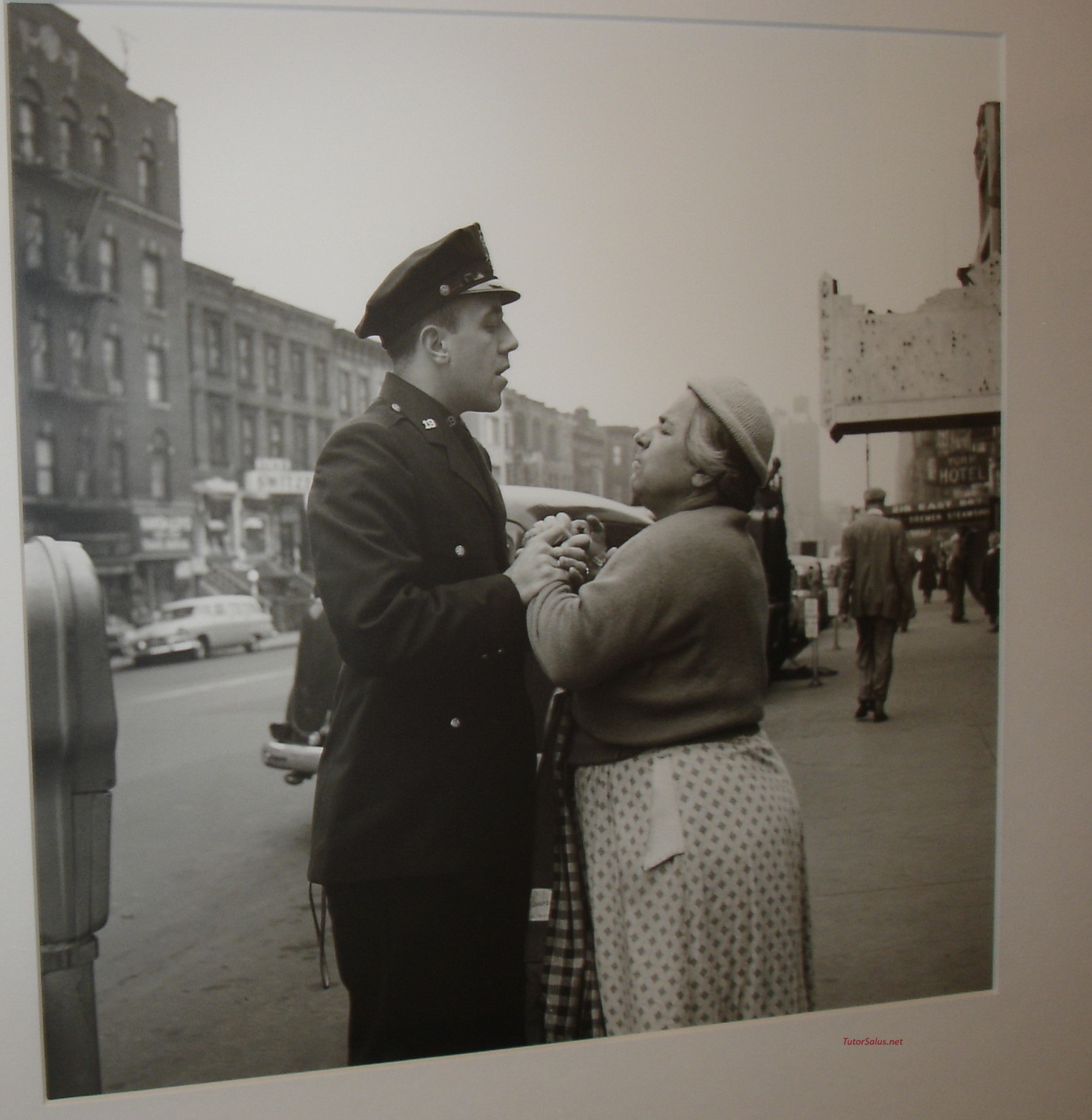
I invite you to know the story of Vivian Maier, who I myself by chance found out about, and then I was able to meet in the beautiful and so far only exhibition set up in Italy, at the MAN Museum[1] in Nuoro, in the elegant building where various exhibitions are housed, also documenting the sober and cultured refinement of 19th century Nuoro.
The exhibition about Vivian Maier’s work unfolds in fact through some rooms with characteristic arched ceilings, connected by the marble staircase on three floors : it offers a rich and selected collection of the incredible quantity of photos taken by the first ‘American woman-street photographer’[2] and found completely by chance by the young and enterprising John Maloof[3] .
Vivian Maier, born in the United States in 1926 and returned as a child in France where her mother’s family lived, then independently came back in the States in 1951, where she immediately looked for a job as ‘nanny’, that is a governess for children in wealthy middle class families. In a number of photos she films the nuns, perhaps not entirely ironically, because in English is written ‘nun’ and pronounced ‘nan’, very close to ‘nanny’ to which Vivian in some way compared herself. But, were indeed enough the stormy emotional events, she almost cinically commented in several photos, of her father and mother to nail her definitively and exclusively to children ?
John Maloof found himself dismayed when faced with an unexpected, enormous quantity of often repeated shots, flashes and kilometers of impressed films, haphazardly piled by Vivian in the trunks of the famouse garage[4] taken over after her death.
Vivian Maier never tried to make public her passion which remained secret even from her employers. They say about her that, in the free time provided for by the employment contract, she could be seen leaving with her ‘Rolleiflex twin-lens reflex’ hanging conspicuously around her neck. And then, seen returning hours later, or after her holiday period has ended, just as she was simply returning to duty : dignified, very tall and silent, with something rigid and absolutely non-sensual in her movements – the children laughed secretly and far away from her, now as adults they admit it.
Vivian Maier’s self-portraits are numerous and often disturbing, almost a first generation selfies to which this Nuoro exhibition dedicates a room. She sends her Rolleiflex forward but the viewer is struck by the difficulty of attributing with certainty to her a sex, and a thinking : boredom, distrust, curiosity ?
Vivian Maier ended up printing very few photos – perhaps for economic reasons, but who knows – and most of these are the result of a very careful work by John Maloof, who exalted their value as well as his own value as a precious tracker of never known artists.
It’s reasonable to assume that Vivian Maier died dissatisfied with the result of her work as a photographer, jealous of every last quintal of film she hid, which not even the employers knew existed, despite having granted her that garage for storage use and that she had begged for her trunks, with a sense of the ridiculous that Vivian herself contributed to being imputed to.
She was unable to convincingly immortalize poverty, the moment in which satisfaction escapes giving in to resignation : yet she had tried in every way. But, despite never attempting new professional paths, with resentment remaining glued to the family where she worked, “… that shot was enough for her…”, as a viewer observes facing with photos which communicate a voyeurism difficult to admit towards prerogatives from which Vivian Maier believed herself excluded.
“Children loved her…”, a visitor woman comments facing with a photo where Vivian holds tightly by the hand the two little children entrusted to her. And they admit, but interviewed today as adults, in a dry tone and respectful of the camera filming them : “She was good…” Today they can finally be grateful to Vivian for something, even just for a brief unexpected success for knowing her as a ‘nanny’.
With an impassive tenacity that slipped into obstinacy, Vivian got to perfection her outfit, the very expensive equipment essential to the ‘street photographer’ of the 1950’s. As she herself soberly confessed, she much preferred the American metropolis with its imbalances, its contrasts, its easy ostentations : she liked the poor and especially their defeats.
Using trains and public transport she traveled elsewhere, but only to take photographs : at the seaside for example, or even abroad, managing to bring the subjects she chose closer than every time, at such a little distance that we can understand how often a serial killer is capable of winning the favour of the chosen victims.
Marina Bilotta Membretti / Cernusco Sul Naviglio – September 27, 2015
TutorSalus.net - Freudian journalism
[1] ‘Vivian Maier – Street photographer’ July 10th – October 18th, 2015 – Museum of Art MAN of Nuoro, Via Sebastiano Satta 27.
[2] ‘Street photography’ is a photographic genre that appeared towards the end of 19th century and until the end of the 1970s when portable machines gradually became established, and intends to shoot public places and subjects in real situations; ‘street’ generally indicates where human activity is visible; framing and timing are key aspects of this photography.
[3] John Maloof (1981, Chicago – Illinois) achieved succes with the documentary – film ‘Finding Vivian Maier’ which was rewarded in 2015 : fond of history and journalism, he began working as a second-han dealer with his father and brother, but John especially revealed remarkable business acumen, indeed admitting that it was his own talent that guided him with confidence in identifying and purchasing Maier’s trunks at a negligible price (380 dollars in 2007), and then transforming Vivian’s pale life into a success.
[4] ‘Finding Vivian Maier’ (2013) is the film directed by John Maloof and Charlie Siskel. John Maloof is also editor of the book ‘Vivian Maier : Street Photographer’ and curator of Vivian Maier’s work.
If ‘The Great Mother’[1] goes to Palazzo Reale.
‘The Great Mother’, Palazzo Reale – Milan (August 26th-November 15th, 2015).

The Great Mother goddess is a hypothetical female and primordial divinity, present in almost all mythologies, through which the Earth manifests itself, and the ability to generate and feed : indeed it seems that the Great Mother specifically concerned the first nomadic populations, who lived by hunting and gathering wild fruit. However in the elegant setting of the rooms of the main floor of the Palazzo Reale in Milan ‘The Great Mother’ offers no nourishment that is no difficult to swallow and digest. “Messages a little too layered…!”, I heard someone comment. The Great Mothers on display are the work of women, contemporary and living artists, even if something comes from Surrealist and Futurist women : but they seem little interested in feeding, perhaps.
In the very long video ‘Grosse fatigue’[2], also winner the Silver Lion at the Venice Festival, gametes are vacantly mentioned, even they are already present in primordial reptiles : man is absent at all. And the children of the exhibition are hungry.
The children of Nathalie Djurberg (1978, Sweden) for example[3]. Nathalie is having success also here in Milan, where it seems that the Art Galleries compete for her. Children in her video ferociously chase the poor woman until they return to their mother’s womb as a clear failure of a nutrition in bad shape. Wouldn’t be easier to realize in time that they were hungry, not only of food but also of thinking and speech ?
I combine that video to Ragnar Kjartansson’s video (Rejkjavik, Iceland) with the hateful repetition of an elegant, robust, elderly woman spitting contemptuously at an indifferent young man in suit and tie, perhaps also contemptuous of her, but already inclined to melancholy hatred : the title, a bit naive, is ‘Me and my Mother’, where the capital letter for ‘Me’ is really disproportionate. Suffer or kill, give up or attack : haven’t we already watched for a little too long this daily pantomime from servility to civil war ? Already more than fifty years ago Carlo Emilio Gadda had abundantly enlightened us about the victim-son who, even coming to know the truth, it would be the greatest achievement because nothing can change. [4]
From ‘The Great Mother’ here it is a flash on Virginia Woolf[5], who offers herself to the photographer in the dress worn by her mother who died a few days ago, a hint of an indefinable smile curves her thin lips : Virginia had been waiting – we are told – for the triumph of that replacement for a long time, and while waiting for which she believed having been prevented from living her own life.
And here it is a small photo of Sigmund Freud with his mother Amalia in 1925[6], while another photo - that Freud himself displayed in the anteroom of his Studio in London - depicts Oedipus who, solving the deadly enigma of the Sphinx[7], becomes king of Thebes and marries the queen Jocasta, thus also freeing the city from the monster of a Great Mother. But, as we say, Oedipus and Jocasta pay dearly for the sudden remorse for their satisfaction : a non-solution is remorse, which does damage right when it is removed.
But it is from young Slovakia, which entered the EU just under twenty years ago, that something interesting and provocative comes from a young artist, and forty-year-old father : Roman Ondak[8] proposes a real and present woman, here teaching her one year old child to walk. It seems that Roman was observing his wife while teaching their little son how to take his first steps, reading the satisfaction of the child who felt accompanied to enter independent adult life. And he was also able to read the satisfaction in his wife to collaborate in the independence of the child : what certainly recalled the artist and the man, since real life is a whole other world, precisely that one that every child wants to enter.
No one, in fact wants to be brought back ‘inside’.
Marina Bilotta Membretti / Cernusco Sul Naviglio - September 18, 2015
TutorSalus.net - Freudian journalism
[1] ‘The Great Mother’, Palazzo Reale – Milan from August 26th to November 15th, 2015 : conceived and promoted by Fondazione Nicola Trussardi together with Comune di Milano and ‘Palazzo Reale per Expo in città 2015’. At care of Massimiliano Gioni.
[2] ‘Grosse fatigue’, Camille Henrot (1978 living, Paris) 2013, Silver Lion Venice, room 15.
[3] ‘It’s the mother’, video by Nathalie Djurberg, room 19
[4] ‘La cognizione del dolore’, Carlo Emilio Gadda(1963) Garzanti editore 2008
[5] Virginia Woolf, room 29.
[6] ‘Sigmund Freud with his mother Amalia’, 1925; ‘Oedipus solves the Sphinx enigma’, J. A. D. Ingres 1808-London, Freud’s Studio, room 4.
[7] Mythological monster with a woman’s body, head of a lion and wings of a bird that devoured anyone who entered Thebes without having guessed an unsolved enigma : “Who, despite having only one voice, transforms into a quadruped, biped, triped ?”
[8] ‘Teaching to walk’, Roman Ondak, Zilina-Slovakia 2002, room 14