

The public debate, including culture, theatre and cinema through the economic perspective of the Freudian journalism.
Events
“Leonardo prisoner of flight”[1].
A special exhibition at Palazzo Morando, Milan.
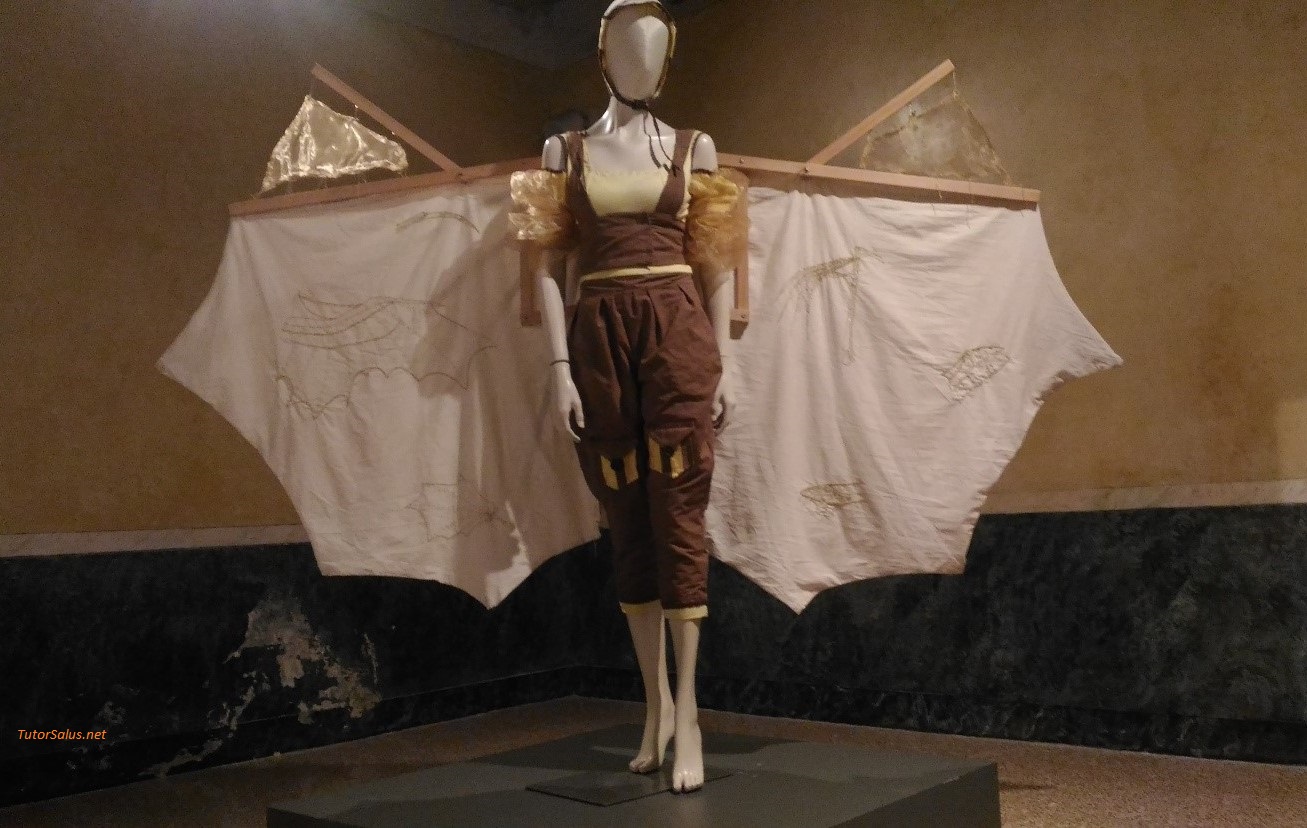
This dress, designed and made by Alice Gariboldi, is inspired by Leonardo flight studies, who today is very much appreciated by youngest people for his wide interests and his own capacity of technical achievements that still remain forerunners. But the intuition of this Project is also in having been able to grasp the anguish of Leonardo himself towards an inhuman perfection, which however he persisted in pursuing in an even growing independence in his relationships.
Curator of the exhibition is Dr. Simona Gallo, ‘Area Giuridico Pedagogica’s authority of ‘Ministero di Grazia e Giustizia’ at ‘Milano Bollate, II Casa di Reclusione – Area III F1’, who could get and promote the wish, born among a few young prisoners, for a specific Project.
One can marvel nowadays at the entrepreneurial ability, when we are weakened by short-sighted chronicles rebound striking our pages at unsustainable speeds.
As a matter of facts we are surprised indeed by this Project which took off in prison, the ‘II Casa di Reclusione’ of ‘Milano Bollate’, where a few young prisoners could think of, propose, plan and make – also capable to collect consent and collaboration, the ‘Teatro della Moda’[2], Milan municipality, ‘Palazzo Morando’[3], the textile industry Ratti Spa[4] generosity other than a number of established stylists’ – 30 evening dresses inspired by Leonardo Da Vinci’ main and most known inventions, as he lived in Milan in the most fruitful years of his own life, whose Milan commemorated in 2019 the 500° anniversary from his death.
With today’s issue a series of short presentations starts of those dresses exposed at Palazzo Morando from December 11, 2019 to January 5, 2020 and for which a public auction sale has been prepared, whose proceeds will go to the benefit of V.I.D.A.S.[5] for free assistance to children with incurable diseases : at the end of these introductions, a more detailed report will be published, thanks to the availability of whom, despite serving a prison sentence, could think of, propose and take care of the Project until its realization.
Opens my review the very dress inspired by the longest, deep studies by Leonardo Da Vinci about the technique of birds flight : as a matter of facts he liked to deepen what he soon became convinced of, that is that the flight is a mechanical phenomenon due to a wing stroke in the air, nothing of mysterious and then that also men could fly, getting wings.
Author of the dress is Alice Gariboldi, student at the ‘Il Teatro della Moda’, and this is how she described her creation for the exhibition.
“…Leonardo reserves an extensive and detailed research to the study of the wing, which evolves over the years. After a number of researches, he seems to lean towards a wing type ‘with doors’ like that of a bat, which is divided into three zones and for which he foresees the use of different naterials… One of the last machines designed by the artist adopts a wing type completely different, with a skeleton similar to that of a hand…
Composed by three pieces (the dress I created – editor’s note) would like to remember the paper on which the notes were written, and also the most used materials by Leonardo, such as wood, the starched linen and cotton.
The colours used are the ones which remember the paper, starting with yellow up to the off-white, made using natural dyes, such the black tea and curcuma.
The high-waisted pants end at mid-calf, have pockets on the knees and on the sides.
The bodice, inspired by a skecth of a painting by Leonardo Da Vinci that portrays Isabella d’Este includes a special closure composed of laces so that it can support the wings on which the notes on flight will be reproduced.
The wings, composed of a wooden structure, have the particularity of being able to open and close…”
Marina Bilotta Membretti / Cernusco sul Naviglio - February 1, 2020
TutorSalus.net - Freudian journalism
[1] “Leonardo prigioniero del volo” is the collective Fashion exhibition just ended in Milan, in which stylists, designers, model makers and painters participated in the creation of thirty original evening dresses inspired by the Leonardo Da Vinci inventions.
[2] “Teatro della Moda – Italian Fashion Institute & Lab”, Advanced tailoring School based in Milan, immediately offered a generous collaboration to the project, with also a specific training into the prison of Milano Bollate.
[3] “Raccolte storiche Palazzo Morando – Costume, moda, immagine”, is in Milan, Via Sant’Andrea n°6.
[4] Ratti Spa, a prestigious Italian textile industry based at Guanzate (Como), provided the fabrics and materials for all the dresses produced by the young prisoners of ‘Milano Bollate’.
[5] V.I.D.A.S.is an Association of already 37 years of activity, operating in Milan, Monza and 112 Municipalities in the two Cities and offering free and continuous assistance to incurable patients : the proceeds of the auction sale of the evening dresses made for the exhibition will be donated to the charity of the ‘Casa Sollievo Bimbi’ at V.I.D.A.S., first children’s hospice in Lombardia, opened in May 2019.
Da do s’passa[1]
The hidden town - Urbino underground [2]
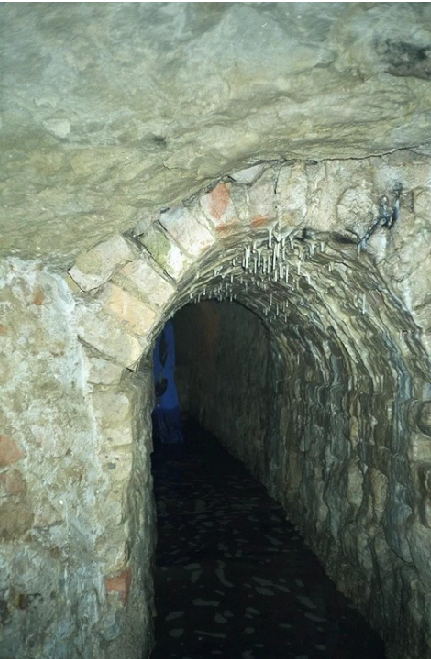
In the picture: screenshot shared with https://www.youtube.com/watch?v=hCPhob2Z-dI Michele Magnoni – G.S.U. Gruppo Speleologico Urbinate. In 1998, thanks to the discovery of the ‘Relazione sulla conduttura della Fonte di S.Lucia di Urbino‘ (1841) it was possible to identify the access well to the Roman Aqueduct with subsequent restoration of the water pipe (2002).
Perhaps few people know that, since the 1st century a.C., Urbino’s territory – Raffaello Sanzio’s native town and which marks in 2020 the 500th anniversary of the artist’s death - and the historic centre itself, located in the in the highest part oft he Hill were equipped, thanks to the presence of wells and sources of underground and rainwater, with an efficient system of large cisterns for collecting water and pipelines for distribution and supply to the built-up area : the most important hydraulic work of which evidence remains is the aqueduct of St. Lucia with a length of approximately 277 metres.
The importance of this ancient system came in handy during the 2nd World War, when the German army destroyed most oft he aqueducts, and the inhabitants did their best to restore the wells and cisterns from the Roman era.
Even the underground of the historic centre and of the Palazzo Ducale itself, made up of permeable rocks that allowed the water to circulate, is still crossed by walkways that began with cracks produced by spring water.
On this characteristic of the underground city a funny dialect comedy was based, and presented last March at the ‘Raffaello Sanzio‘ theater in Urbino : two inhabitants of Urbino, well equipped as a matter of fact with specific maps, decide to reopen the underground route that already existed in antiquity to reach the Palazzo Ducale without having to cross the town.
The maps, difficult to be interpreted, however would not be complete according to the two poor men : infact, essential information is missing, that not even the Technical Office of the Municipality is able to provide… While the beautiful project risks remaining an unsolved enigma, the answer will come from the oneiric in the guise of an ancestor, the Count who lived in the house at the time of the Duke : so geometry alone wouldn’t be enough ?
‘Da do s’passa?‘ – with a question mark though – finally becomes a help, capable of putting even a child to work when, committing himself or herself to be born with all one’s own strength, moves away from the suddenly narrow space of the place, hitherto welcoming, that hosted him, or her.
Marina Bilotta Membretti / Cernusco sul Naviglio – December 24, 2019
TutorSalus.net - Freudian journalism
[1] ‘Da do s’passa’ (Translat: ‘Where you go through’) is a comedy in two acts by Paolo Cappelloni in Urbino dialect, presented last March at the ‘Raffaello Sanzio’ theater of Urbino by the ‘Compagnia dialettale urbinate’, directed by Amleto Santoriello.
[2] ‘La città segreta – Urbino ipogea’, by E.M. Sacchi-F. Venturini-M. Betti/ ‘Gruppo Speleologico Urbino’ / Monacchi Editore 2013
The art of lace[1].
A work by… I! Our thinking no longer tangled.
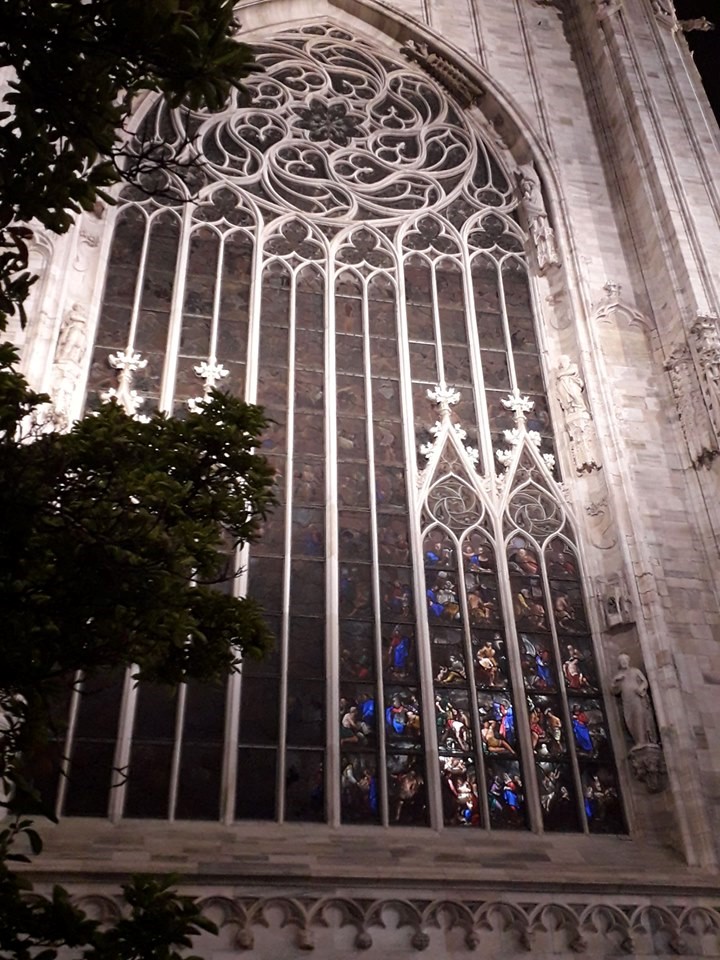
Almost like a precious embroidery can appear the marble decoration from the outside of the Duomo’s apse in Milan, dedicated to ‘Mariae nascenti’.
What makes an embroidery immediately appreciable, and instead unpleasant a tangle of knots ? It is on this that the success of an artefact with very high added value is based, already in use towards the end of the Middle Ages in Italy.
The tools are very simple, the bobbins, the needle and the cylindrical bobbin, but solid technical expertise is required, that cannot be passed down either in words or in books, because it must rely on a good and adequately designed drawing, ‘the trace’.
Courted by noble and later bourgeois patrons, even the workshops Masters of the early Renaissance went so far as to hand over a ‘designer’ sketch, which however then required a special mastery in interpreting the shadows, essential to understand the drawing, until obtaining that thin, precious and resistant artefact of considerable value : so much so that its most sought after use was, and is still now, for haute couture. But lace for sumptuous tapestry and furnishing accessories can even be found in notarial records of spousal contracts, deposited in medieval archives.
The invention of needle-worked lace, which so frequently characterizes 18th century Venetian fashion, perhaps dates back to very ancient times and to distant civilizations that commercial activities brought together : for our Latin ancestors, in fact, needle stitching only concerned ‘mending’ which however rarely comes close to that skilful interweaving of fine threads that makes embroidery.
Suddenly, as a matter of fact in the Middle Ages the display of laces and embroideries makes the appearance, for example in the cities, in the astonishment and in the rivalry of the different Guilds, continuing then in more recent times – as happened in 1888 and then in 1959 for example at Cantù, headquarter of one of the most Italian renowned embroidery’s schools - with the opening of professional and even public schools. The rapid transition of 50s and 60s fashion to modern prêt-à-porter cause a rarefaction of professionalism which leads to an incredible increase in the value and cost of the commissioned product, with the consequent reduction in the number of precious artefacts available to buyers.
Maintaining the ability to create unique ‘pieces’ – even and still designed by contemporary artists[2] - the art of lace remains an invitation to use one’s own thinking, and even more so when it gets tangled restlessly, to unravel the threads and rebuild an order that is very similar to the oneiric and to those night dreams, apparently indecipherable and twisted but real indeed, of which we must admit that we ourselves are the authors.
Marina Bilotta Membretti / Cernusco sul Naviglio – November 13, 2019
TutorSalus.net - Freudian journalism
[1] Thanks to ‘Palazzo Morando’, home of the ‘Museo di Milano’ and of the collection ‘Costume Moda Immagine’ which recently hosted the exhibition ‘Merletti e Design : intrecci creativi a Cantù dal Novecento ad oggi’. Thanks also to the Association ‘Italia Medievale’ for the presentation of ‘L’arte del sarto nel Medioevo. Quando la moda diventa un mestiere’ (2018, Ed. ‘Il Mulino’) by Elisa Tosi Brandi, young researcher in ‘Medieval History’ at the Università degli Studi of Bologna, who specifically studied the history of fashion craftsmanship.
[2] ‘Lombardini22’ is the professional Studio in Milan which designed ‘Cathedral’, a lace that takes inspiration from the ‘endless knot’ by Leonardo Da Vinci, on the occasion of the five hundredth anniversary which is celebrated in Milan, and using techniques applied to digital. NeSpoon is the stage name of a Polish artist who is making herself famous for her ‘street art’ of antique lace with which she decorates city buildings.
A better world.
“What is the right way to land on a better world ?”[1]
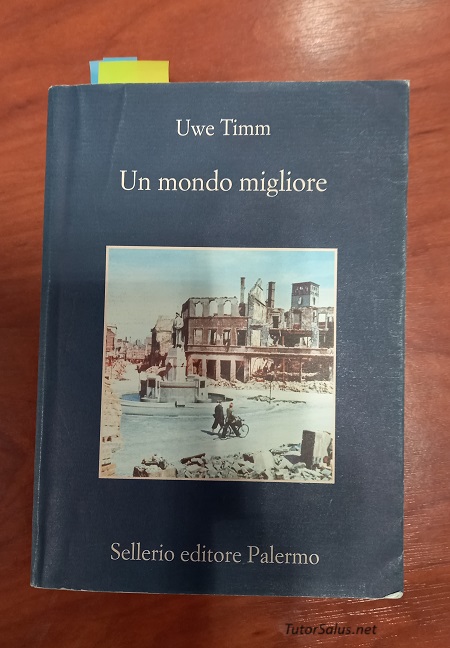
I listened to Uwe Timm[2] who I didn’t know, during his presentation at the ‘Book Pride 2019’ last March the 16th, in Milan : his capacity to reach the individual, in a so crowdy room and without speaking any Italian seemed notable to me.
Nothing obvious in responding his interlocutors – mainly young people, and admirers of his work, clearly sincere – nor any sign of tiredness that might have seemed reasonable on a sultry Saturday afternoon.
There was a beginning, as explained Uwe Timm who remembers little directly about the War because he was born in 1940 : but through his father-in-law, who started out as a socialist and then became a scientist expert in eugenics and euthanasia, Uwe Timm began to wonder what goes on in the mind of a man who begins with ideals of fraternal solidarity and then turn to collaborating for a social community that does not exist, with men and women to be selected according to codified criteria, pledging to fight until the physical elimination of anyone who does not match the established coding…
He began to want to investigate how it could happen that, in those terrible years , so many followed that music and only very few opposed it.
In 1945, lucidly recalled the German writer who was just a few years old at that time, there was a feeling of disgust towards everything that had happened just before, films were screened on the concentration camps : many, everywhere, commented that they would never have imagined anything like this, when their Jewish neighbours were taken away.
And after that initial wave of disgust there was reconstruction, something cathartic that took away the uncomfortable memory along with the rubble.
And after that brisk and vigorous reconstruction, there was the cancellation of everything had happened in the War : the slide from ‘imputability’ to ‘avoidance’ is easy, perversion is called.
Of those frenetic months that followed the occupation of Germany by the United States of America, Uwe Timm remembers with the clear memory of a five-years-old child that suddenly there was an abrupt change, American soldiers even smelled different from German soldiers, on the streets, in the shops, in the offices everyone – everyone – said that they had had to endure the nazism, of having been ‘forced’ to obey ‘against’ their will.
No one even admitted that they had collaborated to obtain ‘a little something’, more or less substantial, that would supplement meager incomes of the time.
Even today - reports a lucid, calm Uwe Timm elegant man of seventy with a refined Alemannic pronunciation - there is a generalized victimization in Germany that makes us think : but then no one was ever a Nazi ?
It’s interesting that the original title of the novel, which arose from the auto-biographical intuition of Timm, is ‘Ikarien’ - that is disceples of ‘Ikaria’ - the utopian community theory of the French founder Etienne Cabet from which the two protagonists, Wagner and Ploetz, come : and ‘Ikaria’ was the ‘commune’ itself, the community then formed in Iowa (U.S.A.) with alternating vicissitudes. The translation, carefully chosen by Matteo Galli for the Italian edition of ‘Sellerio’ is very adequate, ‘Un mondo migliore’ : and leads to the double and opposite meaning of abstract, hateful ‘utopia’ and of constructive, peaceful ‘hope’.
The lemma ‘imputability’ gathers as a matter of fact friends, or enemies : no neutrality.
Marina Bilotta Membretti / Cernusco sul Naviglio – August 30, 2019
TutorSalus.net - Freudian journalism
[1] ‘Un mondo migliore’, by Uwe Timm – 2019 ‘Sellerio editore’ Palermo, p.225
[2] Uwe Timm was born at Hamburg in 1940 : as a writer he has already received a number of awards and reviews, see recently the ‘premio Napoli’ and the ‘premio Mondello’; he is also author of short stories and children’s book, and he also collaborates on radio broadcasts.