

Partner of thinking, and lack. Training as a psychoanalyst.
Thinking as a partner
Je, c’est moi.
The opposition to a gnostic duplicity.
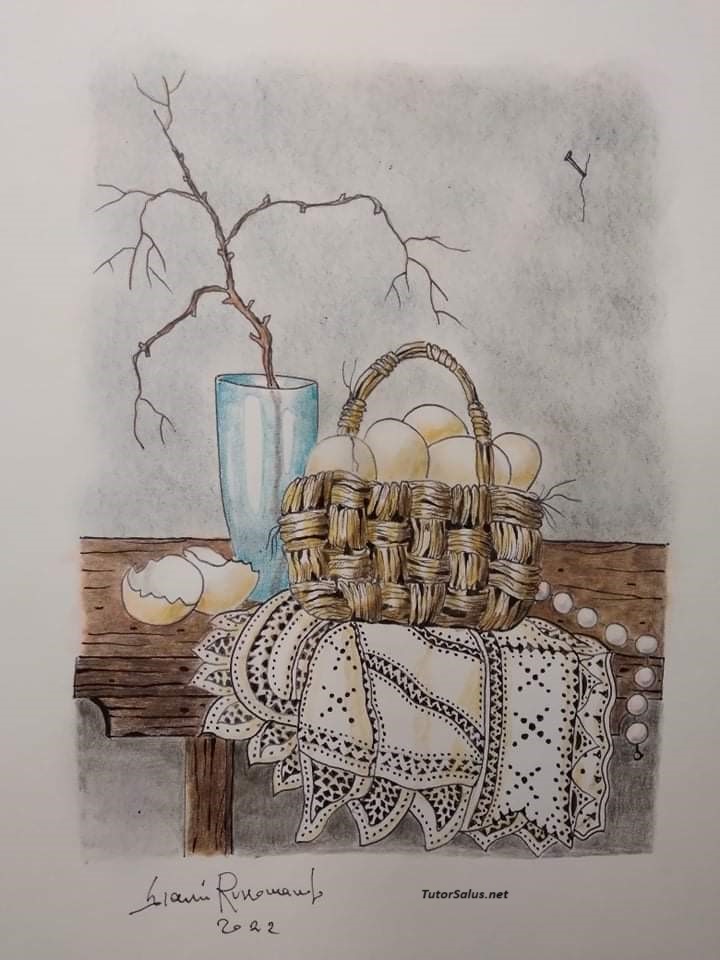
“It’s easy to make explicit the Freudian implicit opposition to gnostic duplicity of ‘I’ : on the one hand an empirical, fluctuating, miserable, mistified and mistifying ‘I’, perhaps (for what it costs) a ‘sinner’, on the other hand a transcendent or transcendental ‘I’ as one prefers, pure, ‘spark’ of the gods that you search and find in ascetism at the end of which he, or she, will be revealed to himself or herself…”[1]
To benefit from one’s calling[2] / 35.
It’s hard to call it an error, when the errors around distract us for good reason : and it is the essential, unimaginable lever space because it does not involve guilt but a stumble.
Because of the rush to go somewhere.
Marina Bilotta Membretti / Cernusco sul Naviglio – July 3, 2024
TutorSalus.net - Freudian journalism
Illustrazione originale di Gianni Russomando[3]
[1] ‘Il pensiero di natura. Dalla psicoanalisi al pensiero giuridico’, Giacomo B. Contri SIC Edizioni (1998) – ‘La Carta o Enciclopedia’, p. 117 Nota 54.
[2] www.tutorsalus.net/index.php/en/pensare-da-partner-2/358-psychoanalyst-and-profession-1
[3] Gianni Russomando, biographical note : “I’m born in Vercelli (1956), graduated at the ‘Istituto di Belle Arti di Vercelli’, I describe myself as an ‘amanuense’ (medieval hand-painter) and far from expositions and competitions.”
Picking up.
There's no latency in thinking at any age.

In the picture, a detail from the ‘Chiostro Maiolicato’ (1310-1340 a.C.) into the ‘Monastero di S. Chiara’, Naples.
“… on one side the essence, on the other the work as servant – once established the divorce between essence and work – with the curious consequence that thinking, as work or elaboration, will be on the side of the servant while, on the side of essence, the only thinking that will remain will be a contemplation. Theory that in its non-motion – is nothing other than fixation on the object. That is, pathology again.”[1]
To benefit from one’s calling / 34[2].
Thinking of solutions move yourself as a partner (not otherwise), the crossroads of one’s faculty to think for appointments is not at all illusory : you bend down to gather yourself in the motion, or to jingle in the mirror.
Are there still those who call ‘latency’ that psychic time that knows no age ?
Marina Bilotta Membretti / Cernusco sul Naviglio – June 24th, 2024.
TutorSalus.net - Freudian journalism
[1] ‘Il pensiero di natura. Dalla psicoanalisi al pensiero giuridico’, Giacomo B. Contri SIC Edizioni (1998) – ‘Ontologia, patologia, diritto’ p. 32
[2] www.tutorsalus.net/index.php/en/pensare-da-partner-2/358-psychoanalyst-and-profession-1
Habit.
It fits just right.

“This does not mean we push criticism into the opposite doctrine and morality of undeceivement, that is, the solution of disinhabiting the inhabited earth as the only possible form of living.”[1]
To benefit from one’s calling / 33[2].
Inhabit one’s body, that’s a goal not so obvious as it’s not so obvious your partner[3], a small margin to pick up, it fits just right : until you can listen to what you say and that naive desire you wear as a habit, to dress up a lack that isn’t there. This is also why such work is called analytic.
Marina Bilotta Membretti / Cernusco sul Naviglio – June 15, 2024
TutorSalus.net - Freudian journalism
Illustrazione originale di Gianni Russomando[4]
[1] ‘Il pensiero di natura. Dalla psicoanalisi al pensiero giuridico’, Giacomo B. Contri – SIC Edizioni (1998), pg.72
[2] www.tutorsalus.net/index.php/en/pensare-da-partner-2/358-psychoanalyst-and-profession-1
[3] “It is in a time-two that the other partner, or more than one, can be identified as a favourable physical presence because they allow to satisfy an ex-citement that would otherwise not be possible. Admitting someone as a partner into one’s own principle of pleasure – that is ‘conjugation’ – and processing it as ‘satisfaction’, is a unique and unremitting goal.”, from ‘Ereditare da un bambino. Perché no ?’, Marina Bilotta Membretti (2014) Gruppo Editoriale L’Espresso SpA ISBN 978-88-91081-63-6, pg. 28
[4] Gianni Russomando, biographical note : “I’m born in Vercelli (1956), graduated at the ‘Istituto di Belle Arti di Vercelli’, I describe myself as an ‘amanuense’ (medieval hand-painter) and far from expositions and competitions.”
At supply-chain school.
‘Thinking’ is not ‘rationalizing’.
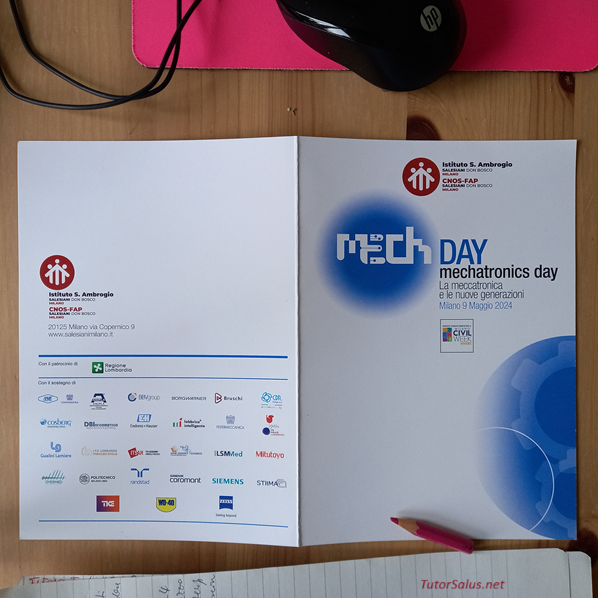
‘Mechatronics Day. La meccatronica e le nuove generazioni… verso la quinta rivoluzione industriale’, Istituto S. Ambrogio ‘Salesiani Don Bosco’ and CNOS-FAP ‘Salesiani Don Bosco’, Via Copernico 9 Milano. In the photo, the cover with the program of the Conference which opened and ended the activities of the day.
To benefit from one’s calling [1] / 32.
“The legislative competence of a Subject lies in making himself, or herself, the apparatus ‘ad-paratus’ to every satisfactory reception from the universe of all others.”[2]
Personally, I am in favour - from my own experience – of a basic learning of mechanics, a school subject to be favoured, and of an introduction of humanistic subjects that follows consolidated learning of different techniques of manual work.
I listened with pleasure from the direct voice of one of the intervened speakers at the ‘Mechatronics Day’ last May 9th, who encouraged professional specialization to ‘train in the supply-chain’ rather than aiming for the result of an absolute, isolated technical competence, as mechanical work was traditionally intended by preceeding generations and in some ways subservient to the object, limited in cultivating collaborations with others, even specialized ones. But what can it teach the most erudites a long and careful training on the lathe ?
First of all, this teaches that ‘thinking’ is not ‘rationalizing’ : in fact it is ‘rationalization’ that ‘serves’ one’s own thinking, in which the other-partner remains even in his, or her, physical absence as a theoretical and experiential reference, because the experience which makes memory effective it is the experience with someone other-than-me who intervened on my behalf. As a matter of fact, we draw on favourable experience to overcome obstacles, on the lathe and in life.
In short, one’s own thinking maintains effectiveness and a specific entrepreneurial capacity, starting from the very original faculty, that is when doesn’t limit to rationalize, calculate, hypothesis without subsisting reality of relationships and slipping into a pathological subservience to Machine, or to Theory – the antinomy of ‘motionless motor’ - rather than maintaining that capacity for synthesis that is not at all innate but, from birth, immediately ready for use.
Technicians are then our excellent allies in science.
Marina Bilotta Membretti / Cernusco sul Naviglio – May 28, 2024
TutorSalus.net - Freudian journalism
[1] www.tutorsalus.net/index.php/en/pensare-da-partner-2/358-psychoanalyst-and-profession-1
[2] Cited from ‘Il pensiero di natura. Dalla psicoanalisi al pensiero giuridico’, by Giacomo B. Contri (1998) SIC Edizioni – ‘Preambolo’ p.72-73