

Excellent notes of economic thinking taken from analytical work.
Strawberries
Aperite portas[1].
“A pleasure that cannot be felt as such.”[2]
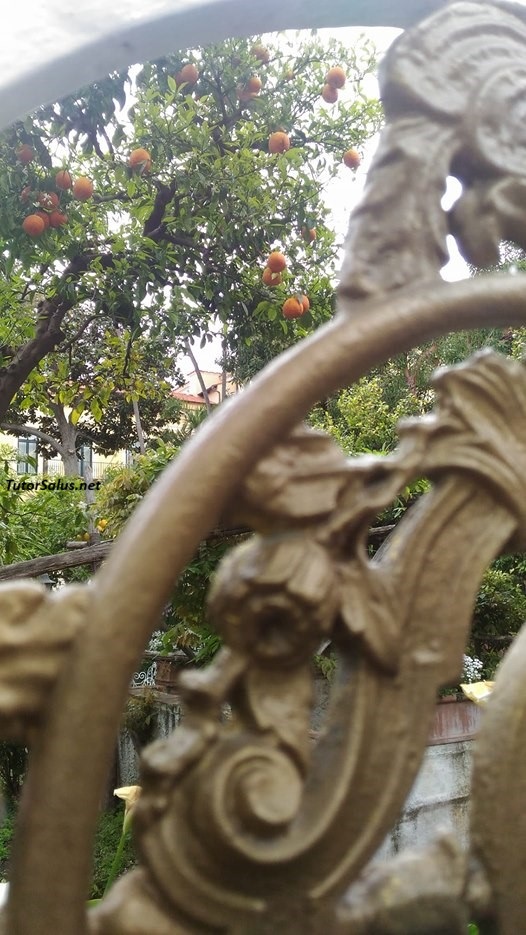
“…The dominant feeling was that of having arrived late: when the most important thing had already happened. The wonderful time was ‘the one before’[3]…”
”Neurosis - which Freud identified as a pathological removal of the individual's orientation toward the principle of pleasure - technically makes use of enchantment, or spellbinding, to always push things a little further, to postpone in the ‘space’ and, above all, in the ‘time’ the work of thinking, and consequently the judgement which guides the individual…”
“In children psychopathology, the gradual work to build thinking comes to a pathological halt when no new representation can replace the previous one, which represents one’s urge (or ‘law of motion’ in one’s thinking ‘nature’ – editor's note): our thinking elaboration gets caught up, stopping on the previous representation, which cannot be replaced because the displeasure would be too deep.” [4]
Marina Bilotta Membretti/ Cernusco sul Naviglio - June 23, 2020
TutorSalus.net – Freudian journalism
[1] “Aperite Portas Redemptori” is the title which the pope Johannes Paulus II chose for the Bull of Indiction of Jubilee for the 1950° anniversary of the Redemption, January 6 - 1983. Here we mean as follows: “Open the doors to thinking”.
[2]‘Aldilà del principio di piacere’, S. Freud (1920) Bollati Boringhieri, OSF Vol.9 p.184
[3] ‘La penombra che abbiamo attraversato’, Lalla Romano (1964) Ed. Einaudi
[4] ‘Inherit from a child. Why not ?’ Marina Bilotta Membretti (2024) NeP edizioni Srls/ p.10; p.32.
The first date.
Virginia Woolf and Sigmund Freud[1].
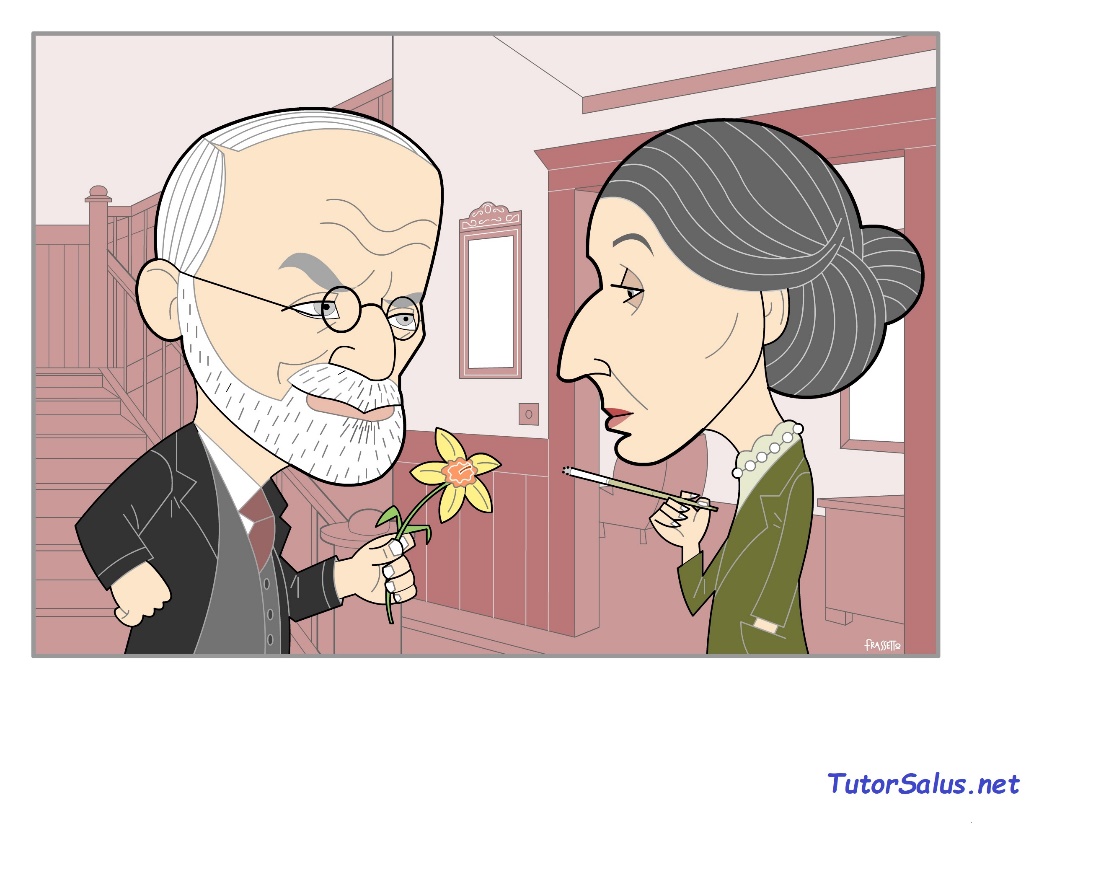
Virginia Woolf in 1939 received by Freud who had just moved to London with his family a few months ago, also due to the Nazi threat.
Original painting by Stefano Frassetto[2] for TutorSalus.net
“…Repeatedly invited by Virginia and Leonard Woolf, Sigmund finally agreed… There was only one meeting… it would take place in the residence-studio of Freud in London, Maresfield Gardens n°20 and it did on January 28, 1939. Virginia, when seeing Freud, considered him not entirely pleased as instead she would have expected, but we know that Sigmund was in great pain at the time.
With his gentlemanly ways, though weary from sickness that bent him, Sigmund bowed to her -present her husband - and handed her a daffodil which she accepted apparently questioningly but showing appreciation, perhaps attributing the choice of the flower to the extravagance of the character. For Freud, however, the offering of the daffodil was the result of his own diagnosis as a psychoanalyst, towards the woman who refused to feed on him.
Virginia started the dialogue having in mind the famous correspondence between Freud and Einstein, ‘Why the war ?’, still suspended. She asked Sigmund : ‘We have often felt guilty… If we had lost the war, perhaps Hitler would not be there…’
Sigmund replied, surprisingly : ‘Oh. It would be infinitely worse, instead, if you hadn’t won the war…’
Virginia, who had received him with reluctance, suddenly lifted her face, paying attention to him.
She will say, then, she was very impressed by the meeting, after which she would have for the first time begun reading the works of Freud…”[3]
Marina Bilotta Membretti / Cernusco sul Naviglio – May 25, 2020
TutorSalus.net - Freudian journalism
[1] In 2006, during the annual ‘Charleston Festival’ – event started in 1916 in London within the ‘Bloomsbury group’ founded by Virginia Woolf – Julia Briggs, journalist and Virginia Woolf’s biographer, reported the conversation she had with Virginia Woolf’s granddaughter, Virginia Nicholson about the unprecedented meeting and about the dialogue done at 20 of Maresfield Gardens between Sigmund Freud and Virginia Woolf, on January 28, 1939. Right in the Nazi years infact, Virginia Woolf insisted with her husband Leonard to get translated and published by ‘Hogarth Press’, the English publishing house they owned ‘The interpretation of dreams’ and ‘Psychopathology of daily life’, works by Freud unknown till then outside Austria : notwithstanding that, Virginia Woolf continued not to read Freud, limiting herself to a few reading samples.
[2] Stefano Frassetto is born in Turin in 1968. After his degree in Architecture at ‘Politecnico’ he begun as graphic novelist for local magazines. In the ‘90s he edited in France too, on ‘Le Réverbère’ and on ‘Libération’ : then he created ‘Ippo’ for ‘Il Giornalino’ and then the stripe ‘35MQ’ for the swiss magazine ‘20 Minuti’. In 2000 he came into ‘La Stampa’ as portraitist for cultural page and the insert ‘Tuttolibri’, then for the weekly ‘Origami’. Today he works also for the swiss magazine ‘Le Temps’.
[3] “Ereditare da un bambino. Perché no ?”, Marina Bilotta Membretti 2014 - Gruppo Editoriale ‘L’Espresso’ Isbn 978-88-91081-63-6, pg.19
Je vous pedagogize.

Painting by Jacopo Ricci[2] / Ref.: 0_5458846_125008.jpg
“ …capability to set rules, that is to establish relationships which are sanctioned according to merit. It is the capacity inherent in a primary citizenship, whose connections don’t look after a protection from the standards of the secondary citizenship, usually known as ‘State law’…”[1]
“ …When being born (zero time) a baby comes in contact with someone else, outside his own, or her, own body-thought, and immediately sanctions that offer in terms of pleasure or displeasure, the displeasure referred to a not well-being : crying does sanction displeasure and dissatisfaction, sleeping does sanction pleasure and satisfaction.
Afterwards (time one) a baby gets to distinguish an ex-citement coming to satisfaction from that one not coming to satisfaction : on his own, or her own a baby can’t satisfy any hunger, vary the light or any outside noise. Also a few organic dysmetabolisms with suffering, diabetes for example or a benign epilepsy can’t yet be diagnosed.
It is in a time-two that one, or more than one, partners can be recognized as a favourable physical presence because they allow the satisfying of a wish or ex-citement otherwise not possible. Accepting someone as a partner in one’s own principle of pleasure – it is the conjugation – and working it out in ‘satisfaction’ is then one and only goal with no coming back.
Any further experiences of pleasure / displeasure will be judged compared with the surplus of satisfaction. The sedation itself will function, from now on, as a surrogate and a substitute, then disappointing.
As a matter of fact a child can now single out his own, or her own well-being in a physical presence of the partner, or partners, arranging his own, or her own thought-body (work-one : offering one’s own thought-body to receive satisfaction is an ‘outside investment’, i.e. work) to receive satisfaction. It is already ‘work’, as it is an individual processing of an unconscious-who-can-no-longer-wait. And it is an investment, i.e. economically oriented.
In a time-three, a child gets to finish (work-two) his own, or her own, demand to the partner.
It is infact in the acknowledgement of this concluding satisfaction, in which a child has been calling, favouring and propitiating the partner to give an offer in order to achieve the goal that he, or she can experience ‘I’, as powerful toward the partner.
Getting to the words can speed up the appointment with the partner, only if that can be linked with a further surplus of satisfaction.
Any data on these four times are irreplaceable in the care of psychopathologies…”[3]
Marina Bilotta Membretti / Cernusco sul Naviglio – April 22, 2020
[1] “Il pensiero di natura”, Giacomo B. Contri SIC Edizioni 1998, p.26
[2] Independent painter in Valenza-Alessandria (Italy), Jacopo Ricci is born in Milan in ‘80s (1988). He loves painting since he was a child but does turn on coloured pencils and brushes just at his Superior degree. He nowadays cooperates with online magazines, also for on demand commissions. In 2018 he illustrated ‘Dottor Tremarella’ and ‘Guarda Oltre’ (published by the author himself). In 2019 began also working on serigraphy.
[3] “Ereditare da un bambino. Perché no ?”, Marina Bilotta Membretti 2014 ISBN 978-88-91081-63-6 Gruppo Editoriale L’Espresso SpA, ‘Un inizio in quattro tempi?’ p.28
Loyalty Doubled.
The true story of Bianca Maria Visconti and Francesco Sforza
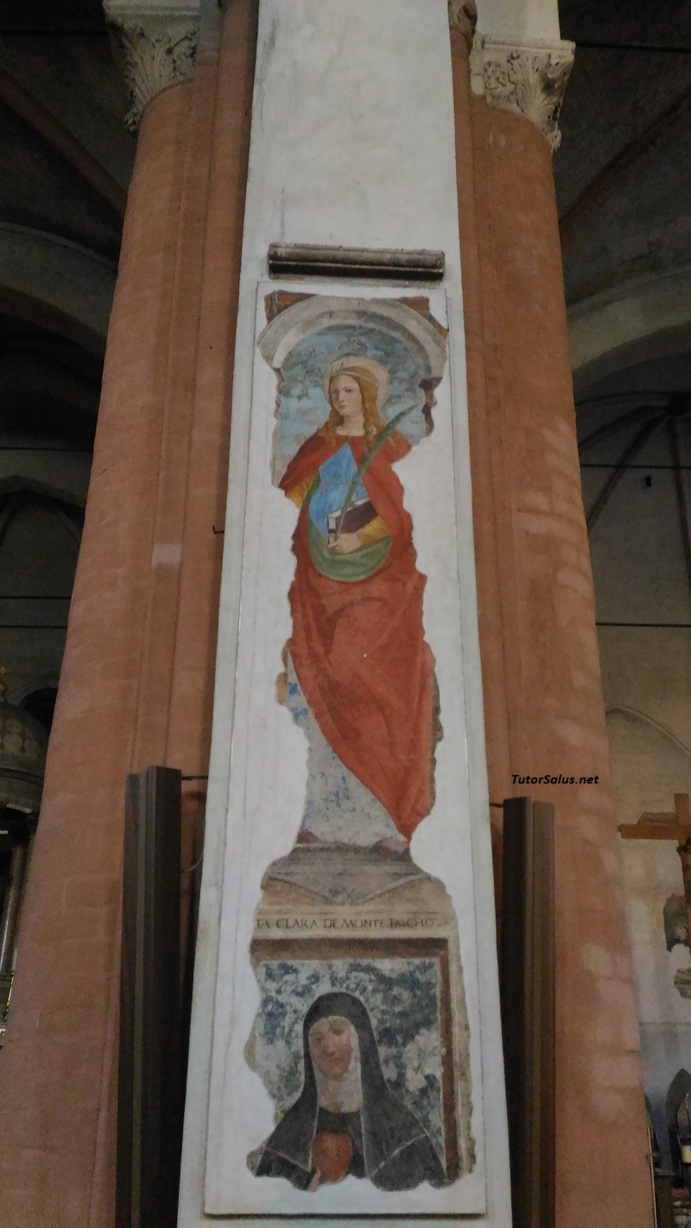
In the photo: a detail of the fresco on the central nave pillar (unknown artist) depicting Saint Catherine of Alexandria and Saint Clare of Montefalco in the church of Santa Maria Incoronata in Milan. My thanks to Maurizio Calì of the Association "Italia Medievale" for the excellent guided tour on March 7, 2020.
Popular among people of Milan but perhaps lesser-known to outsiders, the church of Santa Maria Incoronata was born from the love story of two medieval nobles. Through their marriage, they ensured the continuity and launched the definitive ducal dynasty of the Visconti-Sforza.
The story features Bianca Maria Visconti, the sole heir of the infamous Filippo Maria Visconti. At just five years old, her father betrothed her to Francesco Sforza, a shrewd and enterprising military commander from the region of ‘Marche’, who was twenty-five years her senior. Their lavish wedding, followed by the traditional seven days of public banquets and festivities, was celebrated in 1441 in Cremona, where Bianca Maria Visconti ruled as "comitissa", i.e. countess.
However, the death of Filippo Maria Visconti in 1447 plunged Milan into a political chaos and a civil war. The municipality attempted to defend itself by proclaiming the Golden Ambrosian Republic. Besieged by Bianca Maria's able husband - who went so far as to drain the ‘Navigli canals’ to capture the city - Milan eventually surrendered without resistance. Francesco Sforza entered on horseback through Porta Nuova. Passing by the ‘first’ church of Milan, then called Santa Maria di Garegnano, he chose it as the site to be crowned Duke of Milan in 1451. Next to the church, the Augustinian fathers had already restored their convent, which still preserves today a magnificent cloister and an adjoining library.
In 1461, as a sign of gratitude and loyalty to her husband - who was the main architect of both the Peace of Lodi among Italian States and the renaissance of Milan - Bianca Maria Visconti decided to ‘double’ the church.
She ordered an identical church which would have been built on the right side of the first one, connected to the original one to form only one church with two naves and two apses. The construction continued until 1484, long after Francesco Sforza's death in 1466.
Today, the church remains an unusual and unique gem in Milan. Thanks to Bianca Maria Visconti, it took the name Santa Maria Incoronata.
The original left portal features an image of Mary next to the tombstone of Francesco Sforza. Meanwhile, the new right portal depicts Saint Nicholas of Tolentino, to whom Francesco Sforza was deeply devoted, alongside the tombstone of Bianca Maria Visconti.
The church is elegant, bright, and intimate all at once. It maintains the Late Gothic style typical of many Lombard churches while looking ahead to early Renaissance architecture and the magnificent Bernini.
In a chapel of the original church, visitors can admire a fragment of a rare and splendid fresco by Ambrogio da Fossano, known as ‘Il Bergognone’ (1453–1523), titled ‘Christ in the Winepress’ - perhaps the earliest example of this iconography in Italy - surrounded by scrolls detailing the mystery and miracle of the Eucharistic Sacrament and the Church.
Bianca Maria Visconti, who navigated numerous wars and disputes with great resourcefulness and diplomacy, was the mother of, among others, Galeazzo Maria Sforza and Ludovico il Moro.
Marina Bilotta Membretti/ Cernusco sul Naviglio - 8 marzo 2020
TutorSalus.net - Freudian journalism