

Excellent notes of economic thinking taken from analytical work.
Strawberries
Stumbling block.
Human experience as a stumbling block.
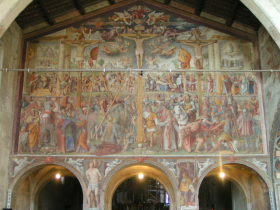
In the picture the great partition wall of 1529, fairly considered the most famous Renaissance fresco of Swiss, a work not just given by Bernardino Luini, but to him commissioned and paid as his own payment receipts to the Sponsors can document.
It is about the rising again : a human experience, then an unavoidable thought, ascribable indeed to an added value and to a further profit. However it is easily rejected… The Sun rises without any work, (that is, it cannot resurrect).
I was thinking about the above, when I was in front of the complicated fresco made by the great master Bernardino Luini, excellent disciple of Leonardo Da’ Vinci and here in his professional maturity making him a demanded teacher throughout Lombardy, Piemonte and up to the Swiss Canton Ticino.
We are in ‘Santa Maria degli Angioli’, charming and simple Romanesque church, standing just a little back on the Lugano lake-front : what visitor would you ever expect, coming to this largest partition wall, about one hundred ten square meters and richly painted, without any visual pause on which a lively city is described, with garnished horses and elegant knights, armed guards and mothers with children, passers-by and common men and women, merchants busying, notaries and shopkeepers while bustling about their daily and provincial jobs ?
If it weren’t for those refined spears, pointed at the three men on the Cross, half-naked and grieving but up there where any glance can’t get. Who ever infact would like to be in their place?
The heresy therefore is winding and winking, indulgent however among the Observants, minor friars coming from Milan, who around 1473 were well received at Lugano due to their work of pacification accomplished among the opposite city factions of Guelphs and Ghibellines, and to their own assistance to plague patients : the convent was founded in 1490 and the first stone of the church was placed in 1499.
Loyal to the ‘Bernardinian module’ which had single nave churches equipped with a partition wall high to the ceiling in order to separate the area reserved for religious, the believers of Lugano were coming here and got Eucharist, but they were assailed by dark sermons and nihilism. Resurrection was an uncomfortable item indeed, in these churches and we find it just allocated into a little corner, upwards on the right side of the fresco, like into a cupboard under lock and key.
In brief, on that enormous and colourful blackboard, the ‘lectio’ clearly says to the assembly to deal with what everyone is entitled to on Earth, so dodging the divine punishment but, on the other hand, thanking the Sponsors, who renewed in 1496 that agreement in remembrance of the peace already drawn up in 1445 among the factions of Lugano, to get an earthly Power in the name of God.
The title for the fresco is ‘Passion and Crucifixion’, where Jesus is diminished to just one of the three men and the ‘imitatio Christi’ – spoken ironically indeed – can’t be a human ambition, but only a leaden servant premonition.
It is too early for that Council in Trento which in the second half of ‘500 had to recall the strength of Carlo Borromeo Cardinal and Bishop of Milan, maybe the only one protagonist, in order to put out the greediness of heresies culminated in the Schism of the Protestant reform ?
Engaged without any energy saving on such a vast field, that saint and also so torn man could at least indicate, by his own humanity, that resurrecting is then possible.
Neverthless, without any delegation.
Marina Bilotta Membretti / Cernusco sul Naviglio – August 5, 2019
TutorSalus.net - Freudian journalism
Habeas corpus[1]
Or: ‘What I am charged with ?’ Hans Kelsen and Aung San Suu Kyi.

In the picture: the bars of removal are very stubborn, but graceful and very decorative.
The idea for this short article came from the reading of two interesting, agile books : ‘Lineamenti di dottrina pura del diritto’[2], by Hans Kelsen and ‘Liberi dalla paura’[3] by Aung San Suu Kyi. Both authors talk about justice, rights, and law.
‘Justice‘ is, in my opinion, one of the earliest thinking in a child, and since birth : ‘justice‘ is in fact his, or her, sanction towards each of the others with whom he finds himself – or herself – dealing; a judgement of liking or non liking what is received, that is the offer from reality. And it is thanks to this early judgement of ‘right‘ or ‘wrong‘, ‘satisfying‘ or ‘not satisfying‘ that every child can elaborate even the relationship with each of his, or her, others.
However, a relationship that, unlike what happens for adults, a child considers indispensable to his, or her, own life : it will be very difficult in fact for him, or her, to get away from an adult who even mistreats him or her, if the adult somehow managest or takes care of the child.
Then, when an adult treats a child as if he himself – or she herself – had been mistreated, from other adults or from ‘his‘, or ‘her‘ society, even the safe judgement of a child is burdened of an injustice suffered from the adult and which the child however isn’t experiencing.
“If you analyze any fact considered as a law, for example a parliamentary resolution, an administrative act, a judicial sentence, a legal transaction, a crime, two elements can be distinguished : the one is a significantly perceptible act which proceeds in space and time, an external event, mostly human behaviour; the other is a meaning, a specific almost immanent meaning or adhering to this act or event… From this arises the need to distinguish the subjective meaning from the objective meaning of an act. Subjective meaning can, but does not have to coincide with objective meaning that this act has in the system of all legal acts, that is in the system of law… When a secret organization, aimed at freeing the homeland from dangerous people, sentences to death an individual they consider a traitor, and have a trusty man carry out what they subjectively believe and call a death sentence, this is objectively, that is in the system of objective law, not an execution of a capital sentence, but rather an assassination… although the external appearance of this is not at all distinguishable from the execution of a capital sentence”[4].
And here’s what Aung San Suu Kyi says. “Since the relationship between fear and corruption is so close, it cannot be surprising that in every society where fear matures, corruption is deeply rooted in all its forms… Something more than the difficulties of building a barely acceptable standard of living had eroded the patience of a traditionally good-natured and acquiescent people : the humiliation of a way of life conditioned by corruption and fear… The Burmese had grown tired of a precarious state of passive apprehension…”[5]
“When you work in the national interest you don’t have to show loyalty towards anyone in particular, nor for short-term goals. Give up personal loyalties. I would like us to continue our journey with sincere unit of purpose and a clear mind. I always tell people to have high aspirations… as high as possible.”[6]
But, even considering “the highest possible aspirations“ which certainly animate Aung San Suu Kyi’s both social commitment and personal sacrifice, her invitation to “give up“ one’s judgement tout court, one’s individual experience of ‘right‘ or ‘non right‘, satisfaction or unsatisfaction, that invitation then can make abstract the rights so hard won.
In fact, submission and rebellion are the unsuccessful result of that same acquiescence, individual first and foremost and then social, as Aung San Suu Kyi herself also remembered, when she admits the “giving up“ of thinking.
Marina Bilotta Membretti, Cernusco sul Naviglio 18 giugno 2016
TutorSalus.net - Freudian journalism
[1] ‘Habeas corpus ad subjiciendum’ (translat. : ‘That the accusation has substance/body’ or literally : ‘That you have your own body’) is a particular order – in English ‘writ’, also said ‘Great writ’ - and of fundamental importance in the English system of law : in the law of origins, each one was subject to a plurality of local and seigneurial jurisdictions which could also physically dispose of the subjects. The text of my Contribution to the debate was presented during the 8th working session of June 11st, 2016 at the Symposium ‘Who can‘, organized by ‘Società Amici del Pensiero - Sigmund Freud‘ 2015 – 2016. An inspiration for this contribution came also from the film ‘Shawshank Redemption‘ (U.S.A. 1994) with Tim Robbins and Morgan Freeman, directed by Frank Darabont, taken from a story by Stephen King.
[2] ‘Lineamenti di dottrina pura del diritto’, Hans Kelsen 1934 – Piccola Biblioteca Einaudi (2016). Hans Kelsen (Prague 1881 – Berkeley/U.S.A. 1973) was a distinguished innovative jurist, who criticized the transcendent idea of law and justice.
[3] ‘Liberi dalla paura’, Aung San Suu Kyi 1991 – Sperling Paperback (2012). Aung San Suu Kyi (Rangoon/Myanmar, former Burma - 1945) is daughter of Bogyoke Aung San, Burmese national hero and leader in the struggle for independence from English colonial rule and from Japanese occupation. She received the ‘Nobel Prize for peace‘ for her own activity in favour of the human rights in 1991, while she was under house arrest in Burma : the award was received by the two sons Alexander and Kim.
[4] ‘Lineamenti di dottrina pura del diritto’, Hans Kelsen 1934 – Piccola Biblioteca Einaudi (2016), pp.48-50
[5] ‘Liberi dalla paura‘, Aung San Suu Kyi 1991 – Sperling Paperback (2012), pp.183-184
[6] ‘Liberi dalla paura‘, Aung San Suu Kyi 1991 – Sperling Paperback (2012), p.217 ‚‘Il ruolo del cittadino nella lotta per la democrazia‘, speech pronounced on December 3, 1988, Burmese National holiday.