

Excellent notes of economic thinking taken from analytical work.
Strawberries
Exquisite.
Every experience was an appointment.
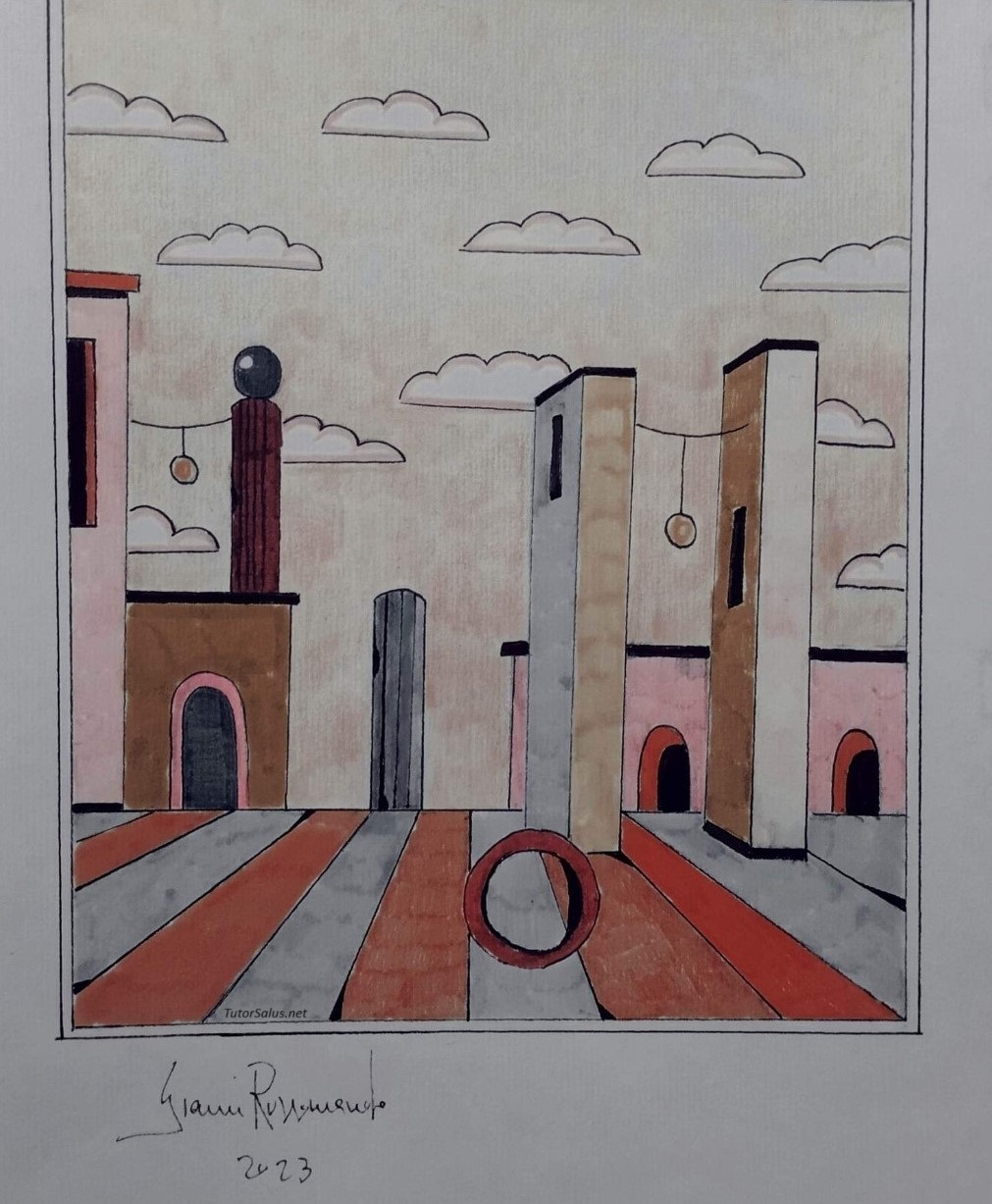
Original painting by Gianni Russomando[1]
“ … Every brain builds circuits and pathways in an extremely individual way : not only because cells and their connections are different in every individual, already at birth but because the experiences which accumulate are different and are coded differently.”[2]
What everyone acknowledges as experience was an appointment : of which everyone is the only keeper. A thinking, as a matter of facts, cannot be automatically transferred, nor in the hypnotic submission.
Marina Bilotta Membretti / Cernusco sul Naviglio – October 16, 2023
TutorSalus.net - Freudian journalism
[1] Gianni Russomando, biographical note : “I’m born in Vercelli (1956), graduated at the ‘Istituto di Belle Arti di Vercelli’, I describe myself as an ‘amanuense’ (medieval hand-painter) and far from expositions and competitions.”
[2] ‘Viaggio nel mondo del paranormale. Indagine sulla parapsicologia’, Piero Angela – Mondadori Libri Spa (ediz. 2022) pg.17
Fog catcher.
The ‘fog nets’.

South Africa, young College student girls in their school break// Taken from the exhibition ‘Sony World Photography Awards 2023’, one of the most prestigious competitions in the world for contemporary photography (Milan, ‘Museo Diocesano Carlo Maria Martini’ July 3 – September 3, 2023). The free contest allows photographers from all the world to find support for their talent : in the four competitions of 2023 edition - Professional, Open, Student, Youth – more than 415.000 images participated from over 200 countries and territories.
The ‘fog nets’ are a project started in Perù almost twenty years ago from an artisanal method which uses the condensation from climatic fogs to integrate water harvesting in the city of Lima, among the most affected in the world by drought.
A friend psychology[1], like the one which healed one’s ousting – removal of the principle of pleasure – is at last able to catch the fogs that others cast on ‘I’, and liquefy them into providential water for one’s mill.
Marina Bilotta Membretti / Cernusco sul Naviglio - September 10, 2023
TutorSalus.net - Freudian journalism
[1] “It’s the capacity inherent in a first citizenship, whose relationships don’t expect protection from the rules of a second citizenship, commonly known as the right of the State…”, ‘Il pensiero di natura. Dalla psicoanalisi al pensiero giuridico’, Giacomo B. Contri – SIC Edizioni (1998), pg. 26
Pride.
The unbroken success of ‘Medea’ by Euripides.
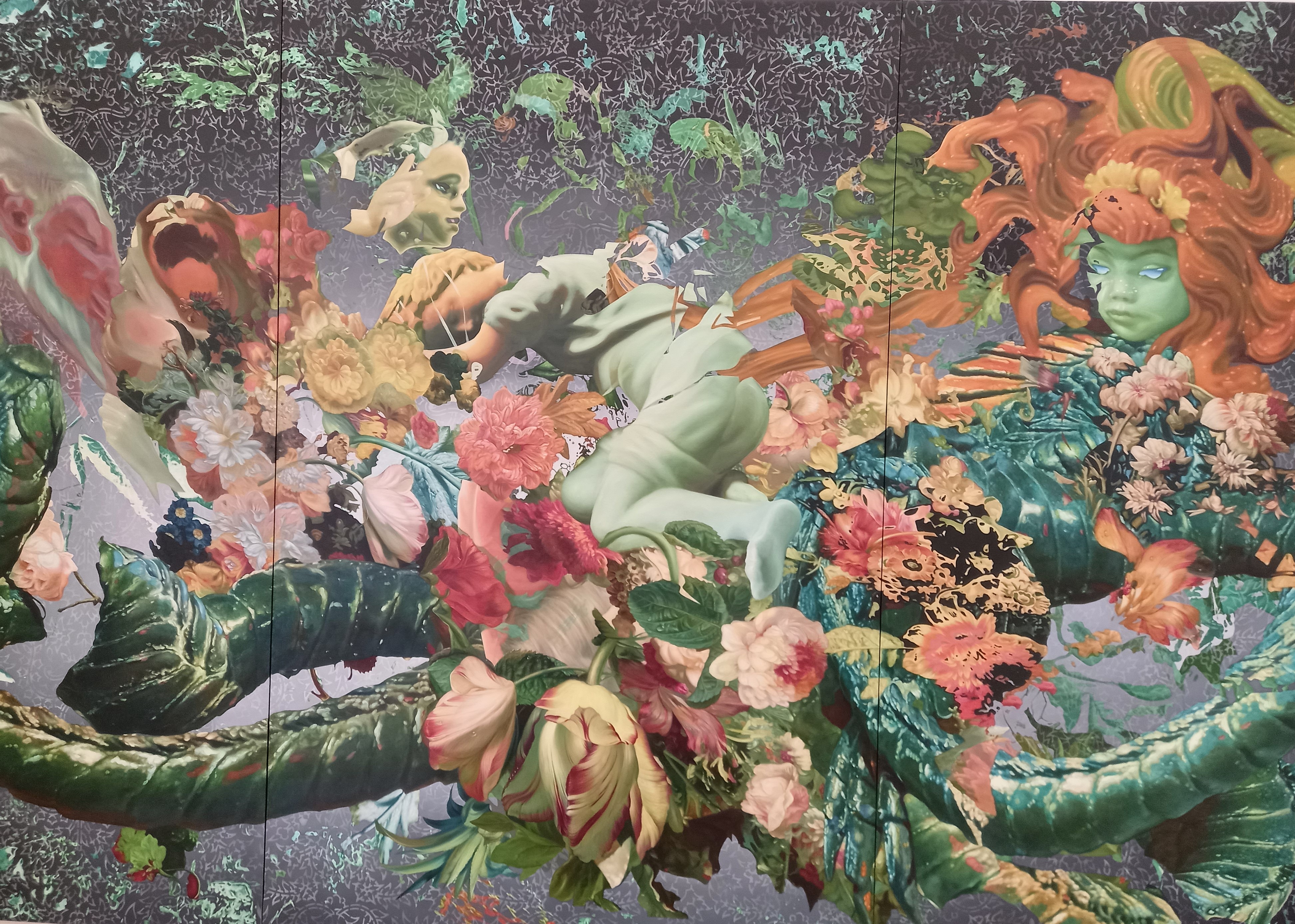
‘Medea and Jason in My Blossoming Garden’ (2023), by Rafael Megall (Yerevan, Armenia – 1983) triptyc, oil on canvas: the artist, who takes up floral and animal motifs from Armenian iconography with the stencil technique, imagines Medea and Jason in the Garden of Eden to compensate the humiliation of Medea-victim in the Greek society where the ‘polis’ was the expression of absolute masculine power // Taken from the contemporary art exhibition ‘Medea’, with works of Italian and foreign artists who accepted the invitation to present their specific elaboration, at the ‘Antico Mercato di Ortigia’, Siracusa May 5 – September 30, 2023. At care of Demetrio Paparoni and promoted by Municipal administration of Siracusa.
The blatant, unbroken success of ‘Medea’ by Euripides (431 b.C.) still disconcerts today, as superhuman pride and phallic ideal of a transnational Culture which knows no time.
This tragedy was presented at the Great Dionysias of 431 b.C. by Euripides, who found himself classified only in third place after Euphorion and Sophocles. It seems that the Judges, including the archon himself and mainly the audience to which the award is due, didn’t like the success of Medea, scornful after killing her own children and the young wife of Jason, who run away on the chariot (‘mechanè’) offered by Sun god (‘deus ex machina’). The story was a provocation indeed, as Euripides described a hero-woman, neglecting the resolute male hero of Sophocles and Aeschylous.
In Greek society of the time, all about antagonism, women barbarians and vanquished were kept on the sidelines. First of all they were denied personal identity, so confirming the mono-sexuality of Greek society. Woman then had to demonstrate her own existence with maternity. Man ‘versus’ woman expresses the Greek man’s hostility towards woman, as also emerges from the current stories of the time, also documented by what Jason says : “It would be necessary that men generate children in a different way, and that the female lineage doesn’t exist”.[1]
Deeply rooted antagonism in culture, which even looks to marriage as unquestionable foundation for the ideological continuity and the succession of properties. For the citizen of the ‘polis’ the marriage is a sacred oath to gods and then inviolable, to the point of calling down the punishments when it is broken. But it is a social contract too, formalizing this antagonism : woman is left without personal identity nor property, even if she gets with marriage the highest social award. Men, and then society, are grateful for the male heirs generated by women, both to their families and to the ‘polis’.
“More in love than wise”, it is the offense by Jason to Medea and anticipates his neurotic enchantment as a naive lover. The antagonism with divorce hostility is evident in that long debate called ‘Agon’. “So is the stupidity of woman, in the weakness of fatigue.” Catching the contradiction between antagonism and partnership in marriage, as a start of crisis in Greek society, Euripides gets to the extreme consequence of infanticide. Even what Euripides thinks about Medea’s act, exposes him to a contradiction. If ‘polis’ infact condemns the massacre – the women of the Choir represent the town of Corinth – gods however don’t condemn her, because the oath of marriage was broken by Jason. So that Medea is an exception in the flat landscape of Greek women, as she doesn’t accept the violation of an oath.
The Greek man is afraid of woman, and hostile : Medea is ‘who thinks up’ and ‘who know how to find remedies, even keeper of a divine knowledge – Medea infact is the niece of Sun god – but she is also ‘who knows about magic potions, poisons, spells’. The verb is ‘medomai’, from which also ‘mother’ derives. Pretious, dangerous, irreplaceable. What to do with the woman then ?
First of all she is not a man, on the sexual side. She has then to remain ‘futòn’, just an animated being, but at the neuter gender as it is used for animals and nature. “The best way and fastest is the poison…”[2] “We women who by nature are unable of noble deeds.”[3]
Medea has come to project a revenge on her own, but she is assimilated to an animal. Jason calls her “killer beast”[4]; her Wetnurse comes back resigned as she saw Medea “change herself in a bull with a gaze of a lioness, just relieved”[5]. Even the king Creon, who has a close dialogue with Medea from ruler to ruler before the massacre, calls her “wise by nature”, but also “expert in many evils”.[6]
Medea, into whom Euripide replaces himself, compares herself to those men bearers of new knowledge who get painful envy and a judgement of uselessness up to nullity, only because they cannot be understood. And confirms[7] : “Justice cannot be found in the eyes of the mortals… In him (Jason) all of them (i.e. women) were entrusted”. And then : “Among all the beings with a soul (‘psychè’) and a reason (‘gnomèn’), we women are the most unhappy beings (‘futòn’)!”[8]
Medea marries Jason with an un precedented freedom for the society where she lives : the oath of marriage is their own partnership, no longer an antagonism between man and woman. Jason is the new man who welcome the woman thinking, to help his own thinking. “This is the best salvation – when the woman is not in conflict with man…”[9] The wetnurse deserves the boldest statement in the Prologue : “Shout the oaths, invoke the right (hands)…, the highest loyalty”.[10]
Jason however will break the conjugal partnership, as he asks Glauce - king Creon Corinth’s daughter - to marry, so forcing Medea to go back to his unacknowledged lover, unidentified female : an arrogance which the Greek society allowed to men.
When preparing the massacre, Medea speaks like the women of Greek society who accept humiliation by man as a law. “It’s necessary that we (women) buy ourselves a groom with an exaggerated price, and this is an evil more painful than the other”.[11] ‘To buy a groom’ is the same as ‘to buy one’s identity document. “I worship Hecate goddess of the shadow (and of death) who inhabits the most hidden part of my home”[12] : psychopathology inhabits the darkness of the unconscious, without judgement and without word, emotion dis-embodied by thought, without any orientation.
The Chorus of Corinth women however ask the Wetnurse, to help Medea, to call her. “Tell her these friendly words too… take her out the house before she harm those inside…” And Medea then : “When a man gets bored being with those at home, he goes outside and puts an end to the boredom of the soul, meets a friend. On the opposite for us (women) it is a must to look at only one soul (‘psychè’) (i.e. the one of man)…” As a matter of facts in the ‘agorà’, public center of the ‘polis’, only the citizens-men can meet each other and talk about political issues. The ‘oikòs’ – the house – is the female realm where the words are useless because the women express with “moans and cries”. “This is all I want from you – says Medea to the Choir – to be silent…”[13] The massacre is prepared in a hateful dumbness, in the dark realm of no-word.
But, despite a few saggings Medea, who was born a ruler and niece of Sun god, is not at all crazy in love, and Jason remains “her bed fellow”[14]. This is also a contraddiction, because only a humiliated victim comes to disavow one’s juridical competence of thought, accepting to be no longer a Subject, just a passive object : this is the Freudian removal, which can go as far as murder and as massacre too.
The anguish for removal doesn’t make thinking, just hateful obedience to the will of the other, hostile to one’s thinking like a despotic Chief. And the mute anguish, without processing can only be sedated : with killing, even physical. The crime from the mother is by a woman without partner : love to children goes through love to partner. Or it doesn’t.
Euripides outlines that Medea is the woman-beast, ‘futòn’, and not human being. But Medea recognizes herself as a ruler and king’s daughter, she has no doubts about her existence as a Subject. In addition she knows that gods agree with her in condemning Jason’s unreliability, as well as the women of Corinth agree and her Wetnurse too. No woman, placed in Medea’ same conditions of dignity, would go so far as to kill her own children. Euripides however arrives at this contraddiction, perhaps because the Greek society wouldn’t accept otherwise.[15]
Marina Bilotta Membretti / Cernusco sul Naviglio - August 23, 2023
TutorSalus.net - Freudian journalism
[1] ‘Euripide. Medea’, translated by C.Azan-V.Fascia, Myzoi series, Simone ed. 2002, Vv. 573
[2] ‘Euripide. Medea’, translat. by C.Azan-V.Fascia, Myzoi series, ed.Simone 2002, Vv. 228; Vv. 374
[3] ‘Euripide. Medea’, translat. by C.Azan-V.Fascia, Myzoi series, ed.Simone 2002, Vv. 407-409
[4] ‘Euripide. Medea’, translat. by C.Azan-V.Fascia, Myzoi series, ed.Simone 2002,Vv 1342
[5] ‘Euripide. Medea’, translat. by C.Azan-V.Fascia, Myzoi series, ed.Simone 2002,Vv. 187-188
[6] ‘Euripide. Medea’, translat. by C.Azan-V.Fascia, Myzoi series, ed.Simone 2002, Vv. 285-286
[7] ‘Euripide. Medea’, translat. by C.Azan-V.Fascia, Myzoi series, ed.Simone 2002, Vv. 218
[8] ‘Euripide. Medea’, translat. by C.Azan-V.Fascia, Myzoi series, ed.Simone 2002,Vv. 230-231
[9] ‘Euripide. Medea’, translat. by C.Azan-V.Fascia, Myzoi series, ed.Simone 2002, Vv. 14-15
[10] ‘Euripide. Medea’, translat. by C.Azan-V.Fascia, Myzoi series, ed.Simone 2002, Vv. 21
[11] ‘Euripide. Medea’, translat. by C.Azan-V.Fascia, Myzoi series, ed.Simone 2002, Vv. 232-234
[12] ‘Euripide. Medea’, translat. by C.Azan-V.Fascia, Myzoi series, ed.Simone 2002, Vv. 384-385; 397
[13] ‘Euripide. Medea’, translat. by C.Azan-V.Fascia, Myzoi series, ed.Simone 2002, Vv.259-268
[14] ‘Euripide. Medea’, translat. by C.Azan-V.Fascia, Myzoi series, ed.Simone 2002, Vv.401-406
[15] This text has been published 2012, July on www.societaamicidelpensiero.it / ‘News’.
De l'eau.

‘La porteuse d’eau’, by Edina Altara [1] (ceramic with wooden frame).
“With his own work, the tailor was able to show investments in textiles, jewels and trimmings assembled into an outfit matching with dresses and ornaments… The tailors were part of this productive economic system, as participating to the moulding of a taste which became cultural value… Almost like a work of Art, each dress was the result of agreements made between the tailor and the client, both sharing the initial project. The final outcome however was the result of a work of haute couture achieved by putting into practice a method which guaranteed the quality of the product along with client satisfaction.”[2]
A psychoanalyst knows about haute couture, it’s logical.
Is it for carelessness then that it is called genre Culture ?
Marina Bilotta Membretti / Cernusco sul Naviglio - August 5, 2023
[1] Edina Altara (1898-1983) was born in Sassari where her talent in drawing very soon made itself known : she participated in 1917 to an exhibition of Art in Turin and her collage, titled ‘Jesus salvadelu’ was acquired by king Vittorio Emanuele III (still today the work can be found in Rome, at the Loggia d’Onore in Quirinale). At first she devoted herself to drawing for ceramic productions (plates, saucers, tiles then framed as in the above picture), in 1934 she went to Milan to collaborate with fashion sketches at the magazine ‘Grazia’, and in 1942 also at the magazine ‘Bellezza’ edited by Giò Ponti, as well as ‘Stile’ and ‘Domus’ and up to collaborations for the furniture of five Italian ocean liners. She was fashion illustrator for the magazine ‘Rakam’, for ‘Il Giornalino della Domenica’ – a publication of ‘Domenica del Corriere’ dedicated to teenagers – for various advertisements (cosmetics, beauty products) and illustrator of novels on magazines. Two exhibitions in the last months did show a few of her most beautiful works : ‘Edina Altara. La mia Sardegna’ at the ’Art Port Gallery’ at Olbia, and ‘Edina Altara. Mondi di carta’ at the ‘Galleria Siotto’at Cagliari.
[2] ‘L’arte del sarto nel Medioevo’, by Elisa Tosi Brandi (2017) Società editrice ‘il Mulino’, pag. 217